
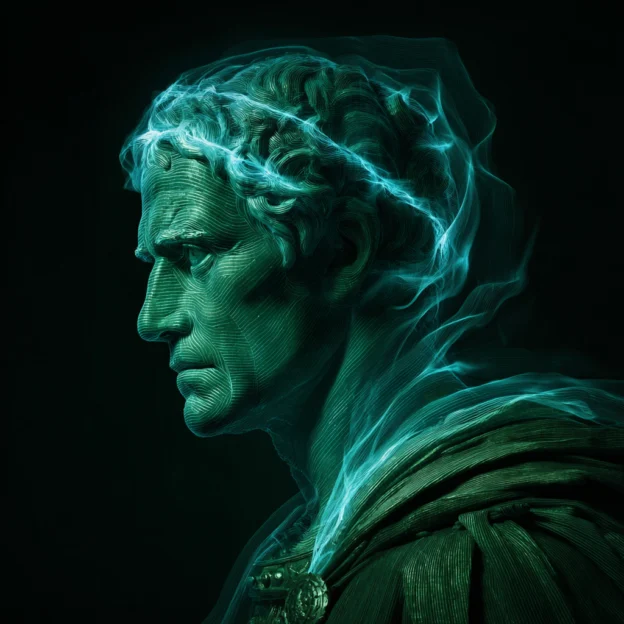
Image by Midjourney.com
The Ides of March was a day known for death and betrayal in ancient Rome. No one knew that better than Julius Caesar, who was stabbed to death by his own senate on March 15, 44 BCE.
Centuries after his death, rumors spread that Caesar’s vengeful spirit had been unleashed upon Rome. Shakespeare even wrote a play that starred the ghost of Julius Caesar. To this day, the locals of Rome claim to see Caesar’s formidable spirit at two spots in the city.
Where Has The Ghost of Julius Caesar Been Seen?
Since the late 16th century, the ghost of Julius Caesar has been reported at two important locations in Rome. The first is the Basilica of St. Peter, where Caesar’s alleged ashes are interred.
The other is the Roman Colosseum. Although neither structure was around in Caesar’s lifetime, they are known hotspots for haunted activity and the most likely spaces to encounter the phantom of the infamous Roman dictator.
The History of Julius Caesar
Gaius Julius Caesar was born into an aristocratic Roman family in 100 BCE. He had three wives: Cornelia, Pompeia, and Calpurnia. Cornelia gave birth to his only child, a daughter named Julia. Julia would later die in childbirth along with her baby, leaving Caesar with no blood heirs.
As he grew into adulthood, he became a formidable warrior with an eye on politics. In 59 BCE, he was elected to the Roman Senate after winning the consulship election. From there, he quickly began consolidating power.
Caesar fought for the working class of Rome and was generally disliked by the conservative faction of the Senate, who did their best to foil Caesar’s policies. However, Caesar rose to power by forming a Triumvirate with two powerful senators, Pompey and Crassus, further solidifying his sway in the Senate.
It became clear that Julius Caesar had bigger aspirations when he led a military campaign to Gaul, which is now France. During his years-long siege, he murdered 400,000 men, women, and children. Caesar knew that if he returned to Rome, he would be prosecuted for war crimes, unless he could stage a coup.
In 49 BCE, Caesar made a daring return to Rome, inciting a three-year civil war that brought Rome to its knees and put him in power. Although the Senate initially offered him a six-month dictatorship, he managed to secure 10 years of nearly unlimited power. Like all dictators, that power went to his head, and eventually became his downfall.
The Assassination of Julius Caesar
By 44 BCE, the Senate had grown tired of Julius Caesar, and the general public was turning on him as well. He had consolidated too much power and grown too big an ego for anyone’s liking.
One of Caesar’s critics in the Senate, Cassius, began talking to other disgruntled senators about ousting Caesar from power. However, there was one major obstacle: Caesar controlled the Roman Army.
As the senators weighed their options, they came to the sobering conclusion that the only way to defeat Caesar was to kill him. An assassination at the Senate was planned for March 15, the Ides of March.
Leading up to the assassination, two events more or less sealed Caesar’s fate. During the Lupercalia festival, Caesar instructed his close advisor, Mark Antony, to place a bejeweled diadem on his head.
As Caesar watched the crowd, he saw a sea of unsmiling faces. The diadem was too king-like for a supposed man of the people. Caesar quickly corrected course by proclaiming that the god Jupiter was the only true king of the Romans.
Soon after, Caesar attended another festival where a cow was sacrificed. The soothsayer presiding over the sacrifice, Spurinna, searched inside the slaughtered cow for its heart but could not find it. Spurinna saw this abnormality as a grave warning for Caesar, telling the dictator to be aware of danger through the Ides of March.
The Fated Day Begins
The morning of Julius Caesar’s assassination, his wife, Calpurnia, awoke in a panic. She’d had a terrible nightmare about Caesar’s death and convinced him not to go to the Senate that day.
It took one of Caesar’s most trusted advisors to go to his home and convince him he needed to come to the Senate. Little did Caesar know that the advisor was in on the plan.
At the Senate, Caesar was bombarded with requests to keep him distracted. When the right moment presented itself, one of the senators drove a knife through Caesar’s neck.
More senators came forward with knives and stabbed him numerous times in the back. They had all agreed to take part in the assassination.
Some believe one of the final blows may have come from Caesar’s longtime confidant, Marcus Junius Brutus. Although it is still debated what Caesar’s final words were, some historians believe it was “Kaì sú, téknon?” In English, this roughly translates to “You too, my child?”
Julius Caesar was dead, but his assassination did not magically take away the problems facing the Roman Republic. Rome devolved into chaos, and from the ashes, Caesar’s heir, Caesar Augustus, rose to power. In many ways, the death of Julius Caesar was the death of the old ways of Roman politics.
The Hauntings of Julius Caesar
Death was hardly the end for Julius Caesar. His larger-than-life persona has haunted history, both figuratively and literally, for thousands of years.
After Caesar’s death, his body was cremated at the Roman Forum. Thousands came to pay respect to their fallen leader. Caesar’s body was placed on a lavish pyre that featured a replica of the Temple of Venus. Citizens placed their belongings alongside Caesar’s body so they could burn with him.
Julius Caesar’s ashes were placed in a lead ball on top of an obelisk in Cairo, Egypt. At least, that’s what some people believe. Other historians believe that his ashes stayed in Rome.
However, this theory is contradicted by the fact that remains were not allowed to be buried in Rome proper. Others speculate that the ashes were buried in the Field of Mars, the Temple of Capitoline, or the Piazza di Monte Citorio.
Whether or not Caesar’s ashes were the ones placed on the obelisk in Egypt, they were brought back to Rome in 37 AD by the Emperor Caligula and placed in the Vatican Circus. They remained there until 1586, when Pope Sixtus V had them moved to the Basilica of St. Peter in Vatican City.
Was a curse activated?
As legend has it, Pope Sixtus V couldn’t help but get a close look at Caesar’s ashes and had the lead ball opened. This apparently unleashed Caesar’s spirit and activated a curse. There are tales that the obelisk containing Caesar’s ashes is still guarded by demons.
As for Caesar’s ghost, he made his first known appearance in William Shakespeare’s play Julius Caesar. In the 1940s, the phrase “Great Caesar’s Ghost” became popular. In 1954, Caesar became a part of pop culture when he appeared in a Superman comic. However, mentions of Caesar’s ghost are not limited to fiction.
There have been countless sightings of Caesar’s ghost near his obelisk at the Basilica of St. Peter. He has also been encountered by tourists and locals at the Roman Colosseum.
Although Rome may no longer be under his control, Caesar’s ghost has made sure to let Rome know that he is still around.
Over 2,000 years after his death, people remember Julius Caesar as the most formidable leader of the Roman Empire. In some ways, however, his murder is more memorable than the ways he shaped Rome. That’s likely one of many reasons for his spirit remaining so restless after two millennia.
https://usghostadventures.com/americas-most-haunted-trending/the-history-assassination-and-hauntings-of-julius-caesar/