
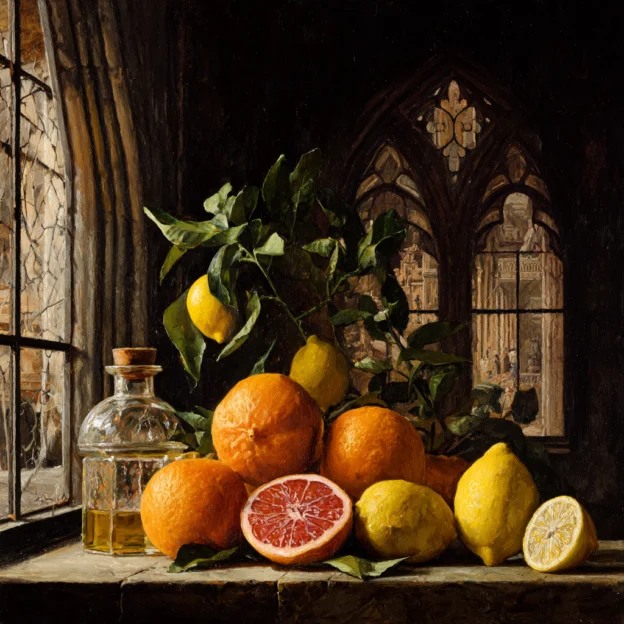
Image by Midjourney.com
Today, we take a look at the English nursery rhyme “Oranges and Lemons” as a repository of folkloric memory, ritual play, and communal identity. Why? Because we can.
We all know this one, don’t we?
To play the game, two children, usually the tallest two of the group, would stand facing each other, each child raising the arms in front of them and clasping the hands of the other to form an arch. The rest of the children would then pass through the arch in turn whilst everyone sang:
“Oranges and Lemons” said the bells of Saint Clements
“You owe me five farthings”said the bells of Saint Martins
“When will you pay me?” said the bells of Old Bailey
“When I grow rich” Said the bells of Shoreditch
“Pray, when will that be?” Said the bells of Stepney
“I do not know” Said the great bell of Bow
Here comes the candle to light you to bed
Here comes the chopper to chop off your head!
During this last two lines,the children forming the arch would drop their arms in a chopping motion to the chant of “Chop! Chop! Chop!” until some unfortunate child who wasn’t moving fast enough to escape got caught. This child was then made prisoner and had to sit the next game out.
*This is the version I know from primary school in Sheffield.
Seems innocent enough, right? And indeed it is an innocent children’s game, played in playgrounds everywhere. But deep down the rhyme encodes traces of religious observance, urban geography, class negotiation, and ritualized violence. It has been theorised to be about child sacrifice, or a description of a public hanging or even Henry VIII marital difficulties. As such, it falls in the lineage of medieval processional songs and execution ballads and like so many others, this rhyme’s enduring appeal lies in its duality – the mingling of merriment and mortality that characterizes much of British folk tradition.
The rhyme’s earliest printed form appears in the 1744 book, “Tommy Thumbs Pretty Song Book” published by Mary Cooper, which brought us forty veritable bangers such as ‘Baa Baa Black Sheep’, ‘Ride a Cock Horse to Banbury Cross’ and the best forgettable ‘Barley Bum’. The original version is somewhat different – more churches, no chopping lines at the end.
Its network of church references -St. Clement’s, St. Martin’s, Old Bailey, Bow, Stepney, and Shoreditch – is very interesting. It maps directly onto London’s ecclesiastical soundscape from the poorer docks where ships brought in – you guessed it – oranges and lemons from Europe, past Saint Martins – Martin of Tours known for his generosity. Old Bailey known for it’s courts that would have dealt with debters. Shoreditch, famous for one of the oldest theatres. Stepney unfortunately known historically mainly for its poverty and violence and all the way to Bow and the poorest slums of the inner city. Viewed allegorically, the sequence of churches could symbolize a moral descent across London’s parishes, from wealth and commerce near the Thames to the darker imagery of debt, sin, and mortality inland. This narrative geography mirrors the medieval morality play’s procession from innocence to judgment.
The invocation of church bells suggests a dialogue between the sacred and the profane. In early modern England, bells were not neutral. They delineated civic jurisdiction, regulated labor, and signaled capital punishment at the Old Bailey. The rhyme’s climactic “chopper” may recall the bellman’s warning that preceded public hangings.Their inclusion in the song transforms architecture into a kind of acoustic folklore.
The refrain of “oranges and lemons,” commodities of trade, evokes London’s mercantile identity. Folklorists have noted that goods like oranges, first imported from Spain and the Mediterranean, symbolized wealth and exoticism. Lemons carried associations with both freshness and bitterness, reflecting the song’s tonal swings between light and death.“Oranges” and “lemons” occupy more than a phonetic function, they encode England’s early global trade networks. The fruits’ presence in a rhyme about London churches fuses Christian ritual (candles, bells) with market capitalism, forming an unconscious theology of exchange.
“You owe me five farthings” evokes both divine and economic reckoning. Five farthings was a lot of money to a street urchin. In fact, at a time when you could be thrown into the debtors jail until you literally starved to death it was a lot of money for anyone. Through repetition across generations, children rehearsed economic morality tales – debt, labor, and atonement. Folk rhymes like this act as microcosms for civic economy, domesticating the anxieties of industrial modernity.
The closing imagery of the candle and chopper anchors “Oranges and Lemons” in Britain’s long fascination with ritualized death. Echoes of the rhyme have surfaced in later literary modernism – T. S. Eliot’s The Waste Land and George Orwell’s 1984, for example – as shorthand for cultural decay and lost innocence. Both writers recognized the folkloric potency of juxtaposing childish melody with fatal consequence.
This tension between play and mortality situates the rhyme within a “memento mori” tradition, where laughter coexists with fear. The endurance of such imagery underscores the collective function of nursery rhymes as mnemonic vessels – they store trauma within rhythm so that it can be safely rehearsed.
And as it was repeated, the rhyme likely merged fragments of church street calls, market cries, and convivial drinking songs. And to this day, oral culture continually reshapes “Oranges and Lemons.” Regional variants adjust church names, reflecting local soundscapes, while modern recordings smooth the violent ending. This moral sanitization parallels the broader Victorian domestication of folklore, in which rough elements were re‑packaged for didactic safety.
Yet, as performance studies note, children instinctively preserve the ritual climax – the “head‑cutting” moment – asserting play as a zone where danger can be imagined and survived. Thus, despite literary editing, the rhyme retains its ritual core.
So beneath it’s childlike cadence,“Oranges and Lemons” is a vestige of London’s spiritual and social history. It is a composite of bell lore, urban cartography, execution ritual, and market ethics. Its folkloric power derives from contradiction – sacred bells toll for secular debts, innocent voices chant of death. In transforming civic noise into communal song, London’s population converted fear into rhythm. An act of collective remembrance disguised as play.
This is what I love about folklore and the study of such nursery rhymes. It reminds us that popular tradition often preserves what formal history forgets. “Oranges and Lemons” is not merely a child’s game but a coded ritual of continuity, where each new voice re‑enacts a city’s long conversation with mortality.