
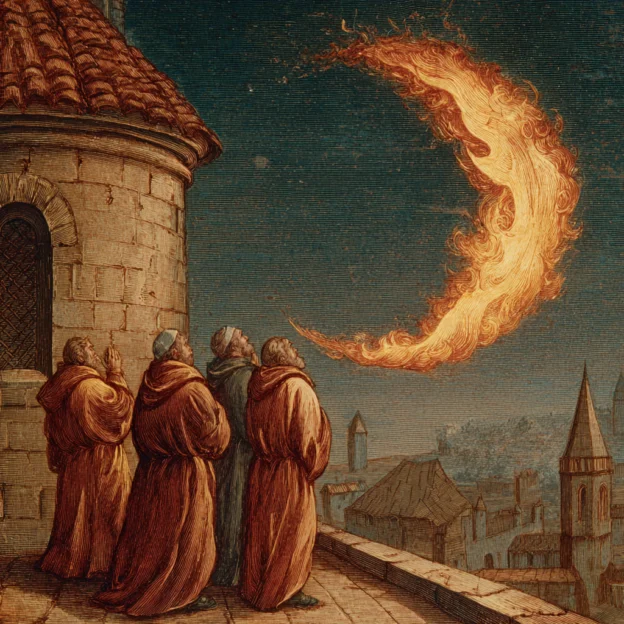
Image by Midjourney.com
On the 18th of June, 1178, just as the Sun dipped below the horizon and the night began to stretch its arms across England, five monks in Canterbury looked skyward – and saw something utterly unexplainable.
What they witnessed wasn’t a comet, nor a star falling from the sky. It wasn’t a saint appearing in the clouds or a holy vision dancing over the cathedral. According to the chronicler Gervase of Canterbury, what they saw was the Moon itself bursting into violent, fiery activity. Not in poetic, spiritual terms, but in full-on cosmic chaos.
As they stood there, robes rustling in the summer breeze, they claimed the Moon’s upper horn split in two, and from the division burst forth a flaming torch, belching fire, hot coals, and sparks. The Moon writhed and throbbed, blackened and trembled, twisting like a living thing in agony. And they weren’t having a shared fever dream. This was witnessed by five separate monks who gave remarkably similar accounts.
The report was so strange, so vivid, that centuries later in the 1970s, American geologist Jack B. Hartung stumbled across it and immediately connected the dots to a fresh-looking lunar crater on the far side of the Moon, Giordano Bruno. It’s about 22 kilometers wide and surrounded by bright rays of ejecta, which in crater-speak usually suggests youth. Hartung put forward a bold theory: what if the monks had actually witnessed the creation of the Giordano Bruno crater in real time? What if a colossal asteroid had smacked into the Moon with such force that it lit up the night sky, ejecting molten debris visible even from medieval Kent?
It’s a delicious idea, the thought of robed monks standing dumbfounded beneath the heavens as the Moon physically convulses before them. But the cosmos, as ever, is full of footnotes. Astronomers immediately pointed out a major problem: an impact of that size would’ve hurled millions of tonnes of lunar rock into space, some of which would’ve been caught by Earth’s gravity and turned our skies into a celestial firework show. A weeks-long meteor storm would have scorched through the atmosphere, lighting up the night with debris – so dramatic that nobody could’ve missed it. Yet not a single chronicle from England, China, the Middle East, or Japan mentions such a thing.
And to complicate matters further, Giordano Bruno is located on the far side of the Moon – the side that never faces Earth. Even in 1178, with clear medieval skies and well-trained monk eyes, there’s just no way they could’ve seen it.
So if they didn’t see a giant impact, what did they see?
One of the most accepted explanations these days is far more grounded (literally.) The monks probably saw a meteor. A bright fireball or bolide, burning up in Earth’s atmosphere, perfectly aligned with the Moon. Imagine – a flaming chunk of rock streaks across the sky at just the right angle so that, to our five sky-gazing monks, it appears to emerge from the Moon itself. As it bursts and fragments, it gives the illusion that the Moon is erupting or breaking apart. Add to that – the weird optical effects you can get with a low-hanging crescent Moon – wobbling, shimmering, even showing colour shifts due to atmospheric distortion – and suddenly you have a recipe for the night’s most celestial spectacle.
But that hasn’t stopped the UFO and UAP community from grabbing hold of the tale and giving it a twist. For decades now, the story of the 1178 Moon incident has been circulating in the fringes of ufology. Some believe the monks may have witnessed a UFO taking off from the Moon, a battle in space, or even a vessel crashing into the lunar surface.
Giordano Bruno, in this light, becomes not a crater but a scar – evidence of conflict, experiment, or intervention. It’s a speculative rabbit hole, of course, but that’s half the fun. After all, medieval accounts of fiery objects in the sky are often reinterpreted through a modern UFO lens, and this one is particularly tantalising.
There’s also the fact that the Moon has long played host to reports of strange lights and flashes, from the “transient lunar phenomena” recorded by astronomers in the 18th and 19th centuries, to the glowing domes and moving shadows seen through early telescopes.
Even in our age of high-definition lunar photography, there are still oddities, brief glows, changes in appearance, moments when seasoned observers scratch their heads. The Moon may be airless and dead by science’s standards, but it’s never been quiet when it comes to mystery.
What makes the 1178 report so compelling is that it was recorded by someone like Gervase, calm, meticulous, and not known for tall tales. These monks weren’t dreaming of rocket ships or little green men. They described what they saw in the terms available to them: fire, light, movement, and upheaval.
Whether they bore witness to a meteor aligning with the Moon, a unique atmospheric illusion, or something more extraordinary, they left us with a piece of historical puzzle – a reminder that the skies have always been a theatre for the strange, the beautiful, and the unexplainable.
So the next time you look up at the crescent Moon and think it’s just hanging there quietly, remember those monks in Canterbury. Eyes wide, jaws slack as their Moon split apart and bled fire. They might not have known what they were seeing, but they knew it wasn’t ordinary. And over 800 years later, we’re still trying to figure it out.
Which, in a world increasingly short on wonder, is exactly the kind of mystery we need.
https://mysterioustimes.co.uk/2025/06/18/the-night-the-moon-cried-fire/