

https://www.midjourney.com
The movie Freaks was made in 1932. Back then, the language used to talk around people with bodily deformities was what we’d now think of as pretty offensive. But it’s the language of the film, and it’s difficult to talk about the film clearly without using its language. And it’s a worthwhile and humane film. It deserves to be talked about. – https://www.room207press.com

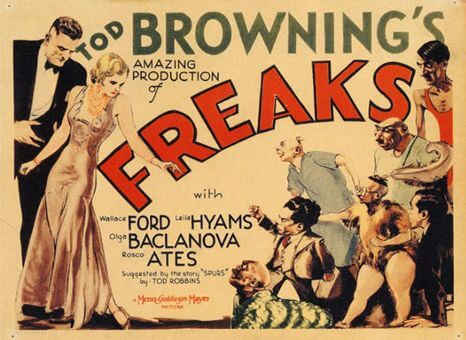
Tod Browning’s Freaks endures as one of the strangest curiosities ever put to celluloid, a film that tests our initial repulsion and challenges our basic human sympathies. Released by Metro-Goldwyn-Mayer in 1932 before Hays Code censorship laws were widely enforced, the film presents a sordid melodrama and morality play set around circus sideshow performers, all played by authentic “freaks” of the era—everyone from dwarves to conjoined twins to “The Human Torso” make appearances. As a carnival barker might announce, No makeup was used to create these fascinating deformities!, although in this case, the claim is true. Audiences and critics shunned the film for showcasing actual abnormalities of nature, and it was in some cases banished for decades after its release. Browning, a member of several circuses in his early years, sought to surpass the horrors of Dracula, his classic released the previous year; yet, he also wanted to humanize his atypical performers. His clashing, problematic ambitions resulted in a film that explores our darkest nightmares and then shames us for feeling terrified or appalled. And for many viewers, the nightmare was far too real to categorize as escapism.
Regarded as the “Edgar Allen Poe of cinema”, Browning explored the macabre in his films, tales in which physical grotesqueries represent an elusive inner disorder. For critic and historian Stuart Rosenthal, who wrote the first scholarly consideration of the director’s work in 1975, Browning’s attraction to such themes followed almost “compulsive” drives. These themes were evident onscreen, and so often implemented that they are seemingly interchangeable from film to film. And yet, in Freaks, that formula is turned upside-down by populating his film with sideshow attractions, all contrasted by a beautiful “normal” woman whose murderous vanity reflects her personal ugliness. Of course, the freaks have their violent retribution as well, but they are not villains or horrible people, rather honest and trusting individuals living by a strict code—“offend one and offend them all”. Only a few studies of Browning have been conducted from a critical-biographical standpoint, and none during his lifetime. He rarely talked about his work in film, but went on at length about his years as a circus performer. In interviews conducted toward the end of his life, Browning related varying accounts of his history, all filled with half-truths and embellishments one would almost expect from a former carnie, yet all with some basis in fact.
The screen story involves duplicitous trapeze artist Cleopatra (Olga Baclanova) seducing sideshow midget Hans (Earles) for his inheritance. Hans’ reluctant friends, the other sideshow attractions, resist allowing her into their clan, until Hans maintains her love is genuine. Finally they are married, and at the reception the freaks admit Cleopatra, chanting their ritualized initiation: “Gooble-goble, gooble-goble! …We accept her! …One of us, one of us!” Drunk at the ceremony, Cleopatra reveals her true feelings, insults the freaks, and tosses wine in their faces; her affair with strong man Hercules (Henry Victor) becomes apparent as they kiss in front of everyone. After, the lovelorn Hans remains with his new wife, though she slowly poisons him. Performer Venus (Leila Hyams) overhears Cleopatra expounding her plot to run away with Hans’ money after his death and tells the others. That rainy, storming night on the road, the freaks band together by Hans’ orders, crawling through the mud with knives in their mouths and weapons in their hands. They cut up Hercules and chase Cleopatra into the woods, reforming her body through mutilation into that of a “Human Duck”—her sideshow title, as a ringmaster informs onlookers in the last scene where Cleopatra is shown on display at the bottom of a pit, squawking and legless.
Casting director Ben Piazza scouted East Coast sideshows for a month to find only the best talent, sending pictures back to Hollywood for Browning to approve. Piazza found a surplus of carnival performers; among those rejected were an “elephant skinned” girl, a boy with dog legs, a tattooed man, a “giant”, a whole team of pygmies, and a renowned midget performer known as Major Mite. Browning hand-picked the individuals who appear in the film: Koo Koo (“the bird girl from Mars”) suffered from the rapid aging disease called Progeria; the torso of Johnny Eck (real name Johnny Eckhart) ended below his rib cage; Olga Roderick was the resident bearded lady; Prince Randian had no arms or legs but could roll and match-light a cigarette using only his mouth; the pinhead Schlitze (real name Simon Metz) led a whole group of his kind (victims of Microcephaly, more commonly known as pinheads; in the circus they were called “the missing link” and were sometimes associated with Australian or Aztec cultures); and Betty Green (“the stork woman”), who suffered from no anomalies, but opted to use her supreme unattractiveness as a gimmick. Also appearing are two armless women, a human skeleton, a “turtle girl”, a sword swallower, a hermaphrodite, and others.
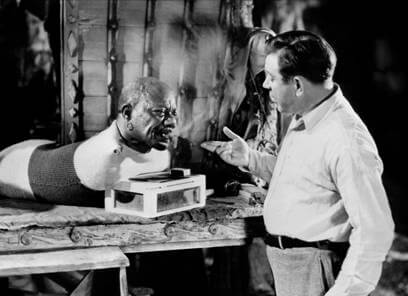 What Browning and his crew discovered was that, typically, each sideshow has one genuinely deformed performer, such as conjoined twins, a bearded lady, pinheads, etc. All the rest are “normal” people in costume as padding for the authentic main event. But when Browning chose a whole cast’s worth of true freaks, he found each one was accustomed to being the star of their show, and thus each one behaved like a prima donna on set. Rather than forming a bond from their shared maladies during production, their egos clashed. Browning told a reporter later that the freaks’ “professional jealousy was amazing. Not one of them had a good word for the other.” They were proud and vain, more aghast by the other freaks’ physical maladies than their own. Several began wearing sunglasses and acting like movie stars, although most would never appear on celluloid again. Despite their egos, shooting proceeded without much incident in terms of publicity, except when producer Harry Rapf insisted that the freaks eat in a separate mess hall “so people could get to eat in the commissary without throwing up.” Rapf’s comments seemed harsh until F. Scott Fitzgerald, near the end of an MGM screenwriting gig, was joined in the commissary for lunch by the famed conjoined twins Daisy and Violet Hilton and lost his lunch (he recounted the incident in his story Crazy Sundays). Resulting from their treatment, as well as their representation and later reactions to the film, many of the performers involved would regret appearing in the film.
Browning accepted the freaks and felt at home around them, even at their worse. A number of the performers proved to be unpredictable. “Once in a while they became upset,” Browning told an interviewer, “and would try to vent their rage in biting the person nearest to them. I was bitten once.” Then again, some like Schlitze were even-tempered and well-behaved; Schlitze, a bright and joyous personality onscreen, even gained the esteem of studio actress Norma Shearer. Regardless of their behavior, Browning loved the deformed performers and being around them; he befriended many of them, the half-man Johnny Eck above all (Eck was known to ride the camera dolly with the director). As evident in his films, particularly those with Chaney, Browning enjoyed oddity in both a psychological and physical sense. But Chaney became grotesque with movie makeup; these performers’ deformities were real, and so Browning loved them all the more.
MGM launched a defensive campaign to spin the film as a deeply human story, rather than a monstrous exploitation film. Borrowing cues from The Merchant of Venice, ads called for understanding. Headlines read “What about abnormal people? They have their lives, too!” and continued “Have they no right to love?” (If you prick them, do they not bleed?)Rare praise came from gossip columnist Louella O. Parsons and critic Charles E. Lewis of the Motion Picture Herald, but their minority opinions faded into the milieu of angry, offended reactions. The preponderance of critics lambasted the film. John C. Moffitt of the Kansas City Star wrote, “It took a weak mind to produce it and it takes a strong stomach to look at it.” The Atlanta Journal said the film “transcends the fascinatingly horrible, leaving the spectator appalled.” Richard D. Watts, Jr. of the New York Herald-Tribune wrote, “it is obviously an unhealthy and generally disagreeable work.” Pulled from circulation in most areas, Great Britain went the furthest and banned the film for the next thirty years.
 In all, Freaks cost MGM around $315 thousand and the film lost $165 thousand. Browning remained baffled by the reaction into his last days. He never understood that its reality—the appearance of people distorted not by Hollywood effects but by Nature—was too much for mainstream audiences. George Mitchell Jr., a Silent Era reader for Universal, once remarked that “we all like to see ugly things… We are all attracted, to a certain extent, to that which is hideous. But when it passes a certain point, the attraction dies and we suffer a feeling of repulsion and nausea.” This seems to be what happened with audiences in 1932, many the same viewers who lauded the monstrosity and morbidity behind Dracula the previous year. Browning’s career would never recover from this blow, having pushed his audiences too far. His films, such as The Unholy Three, had tested audiences before, but as they were profitable his risks were justified. Hollywood viewed this as an utter failure on Browning’s part. After Freaks was released, Browning tried to develop a picture in which Eck could star, a tale about surgical experimentation, but it never panned out. Studios refused to fund a Browning project, especially one involving bodily disfigurement, sideshows, or even commercial horror. He made only a handful of films after Freaks. His last picture, about an illusionist, was called Miracles for Sale and was released in 1939. Browning officially retired to Malibu in 1942 and became a recluse; he died in 1962 at the age of 82.
Today, the film has garnered some esteem as a controversial and must-see picture from the Pre-Code era, but it remains a curiosity nonetheless. Tonally, an audience can never seem to reconcile if Browning’s film is pure horror or a melodrama staged around sideshow characters. Browning may not have known himself, as he calls for humanization of the seemingly inhuman freaks, and yet he dwells on their maladies like a sideshow gawker, at times reducing the picture to exploitative voyeurism. And certainly the almost comic treatment of the conclusion’s “Human Duck” trivializes any pure dramatic intentions, delivering an ending on par with your average Tales from the Crypt horror story. But reducing the picture to a mere horror film would be a mistake, despite the sideshow guise.
We are still supposed to be on their side, after all, and the dissonance involved in accepting both their humanity and approving of what they do at the end was simply the dissonance we get when good people do bad things for good reason. The film isn’t framed any other way, and it’s underlined by the way that Hercules comes to kill Venus, and Phroso and his fellow performers rescue her, even while they’re coming for the murderous trapeze artist.

And the film’s most disturbing element is the fate of Cleopatra. We don’t see what they do to her, only the result, where she is the legless, deformed “chicken woman”, unable to do anything other than squawk, and unable to earn a living anywhere else.
But this isn’t such a bad ending. If the full range of human expression is permitted to the sideshow people, why isn’t revenge part of that. We are often disturbed by the idea that a person with a disability might not be a saint, we often assume it, but why don’t people with disabilities get to be vengeful or violent? It’s just as prejudiced to assume that people with disabilities and deformities are always saints. They’re not monsters, but very few people are; the film has spent most of its hour-long running time underlining that. But it’s precisely because they are so decisively human that they have the right to be the sort of people who want revenge, and revenge taken entirely out of their solidarity with each other, a solidarity that is openly extended to anyone who will take it. The worst punishment they can inflict on Cleopatra is for her to become one of them – and she is now one of them, and no doubt is afforded the solidarity of acceptance among them because she’s not going to get it anywhere else – not because it’s the worst punishment they can imagine, or that being one of them is a sentence, but because it’s the worst thing that she can imagine, and “freak” is the worst insult she can bring herself to level. – https://www.room207press.com
Still, Freaks is much more than simply a filmic sideshow with human oddities on display for the masses to point at and ridicule, and much more complicated than a one-note horror yarn. The film operates on multiple planes, reviling some viewers and engrossing others. Through a variety of incongruous themes and several shortcomings, the film endures, begging to be watched again and again. No matter how you react to the film, you will react. But unlike today’s provocateur directors trying to test the limits of censorship with gore and makeup, Browning sews together our natural fear of what is different with a real human drama through the misshapen exterior of his characters, who, of course, are humans too. In turn, he may not have achieved all of his cinematic aspirations with this film, but he created something unforgettable that could not and will not ever be matched or replicated; our politically correct world would simply never allow it. For that, we must savor Freaks as a genuine rarity about all that is ugly and beautiful about being human.
https://www.deepfocusreview.com
Nothing changes… these days being different leads to violence born of discontent and wrong choices.