
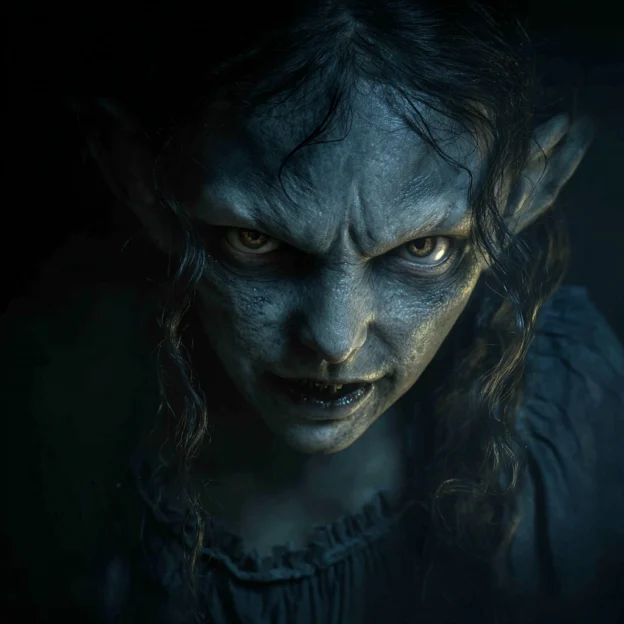
Image by Midjourney.com
Its Name Was Mormo is a 2024 horror film directed by Mark Andrew Bowers that weaves a chilling narrative rooted in Greek mythology. The film explores the haunting presence of Mormo, an ancient figure associated with night and fear, and how this malevolent force disrupts the lives of a young family. The story follows a family whose seemingly normal life spirals into chaos as they become targets of Mormo. Each family member experiences unique and sinister encounters with the entity, leading to a gradual unraveling of their relationships and sanity. This layered approach to horror not only emphasizes individual fears but also highlights the collective terror that binds them together.1
In legend: The name “Mormo” (Greek Μορμώ, translit. Mormṓ) is usually thought to have meant “terrible.” In fact, the name could be used not only for the monstrous female spirit called Mormo but for any frightening person or thing.
Mormo was a female spirit or phantom, a ghostly being known for inspiring fear. Like Lamia or Gello, Mormo was used above all to frighten children; in fact, she was sometimes considered interchangeable with Lamia, Gello, or the strix, a vampire-like bird of the night that fed on the blood of children.
Ancient writings do not provide much detail on Mormo. According to one source, she was associated with horses and perhaps had equine characteristics. She may have also been associated with other animals: her alternative names “Mormolyce” and “Mormolycia” suggest a connection with wolves (the Greek λύκος/lýkos means “wolf”). Another source represents Mormo with large ears and a long tongue, dashing about on all fours, implying that she had the ability to change her shape at will. This was a quality shared by many spirits of Greek lore. The name “Mormo” was generally synonymous with “fear.” Perhaps as an extension of this, the term “Mormolycia” could also refer to the grotesque masks used in ancient performances of comic plays.
Morno’s realm of influence stretches as vast and impenetrable as the night sky itself. As the embodiment of twilight and darkness, he commands the shadows, intricately weaving them into webs of illusion and allure. Myths echo with tales of his unseen traversals between mortal realms and divine domains, hinting at a mastery over unseen boundaries. Prophecy whispers of his ability to peer through the veils of time, glimpsing fragments of the future. Yet, Morno’s true might lies not in grand displays of power, but in the subtle sway he holds over the hearts and minds of mortals.
In contrast, Mormo’s power emanates from the primal fear she instills in those who cross her path. Linked to horses and wolves, symbols of adaptation and transformation, she embodies the duality of human nature, capable of shape-shifting and blending seamlessly into the shadows. While her abilities remain shrouded in mystery, her capacity to evoke dread stands as a testament to her formidable presence.
However, Morno’s powers remain a subject of conjecture due to the scarcity of concrete information. Theories abound regarding his potential functions, ranging from inducing sorrow and despair to serving as a harbinger of death, foretelling the mortal coil’s final embrace. Some speculate he may assume a role akin to that of Hades or Persephone, safeguarding the realms of the dead, ensuring souls remain within the confines of the underworld. Amidst the ambiguity, Mormo’s essence persists as an enigmatic force, beckoning seekers to unravel the mysteries veiled within the shadows of ancient myth.3
1.https://vocal.media/critique/its-name-was-mormo-review-a-horror-story-based-on-a-greek-myth
2.Avi Kapach – https://mythopedia.com/topics/mormo/
3https://mythlok.com/mormo/