
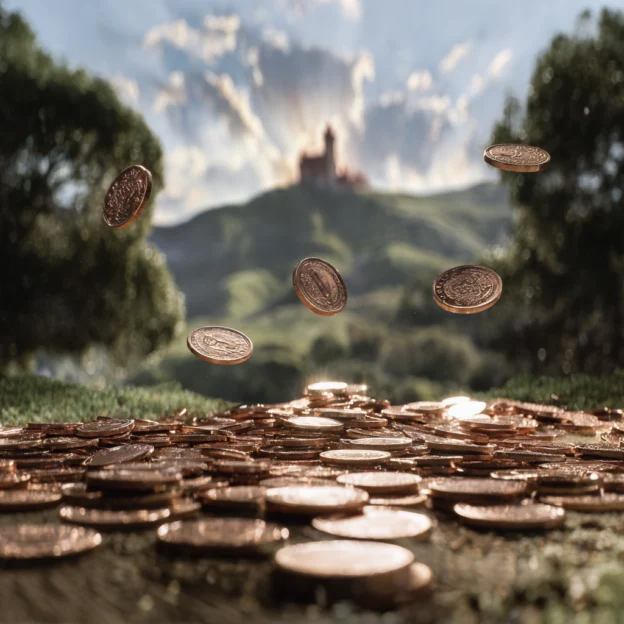
Image by Midjourney.com
“Find a penny, pick it up, and all day you’ll have good luck.”
People love the lucky penny for a variety of reasons. Firstly, these small coins carry a sense of nostalgia and tradition. Many individuals grew up hearing stories or beliefs surrounding the luck that a penny can bring, passed down from generation to generation. Additionally, finding a penny, especially in unexpected or serendipitous moments, gives a sense of excitement and hope. It serves as a reminder that even the smallest things in life can hold significance and bring about positive outcomes.
Moreover, the idea of a lucky penny provides a comforting and tangible symbol of good fortune, offering a sense of reassurance during challenging times. Whether it’s carried in a pocket, placed in a jar, or simply cherished for its symbolism, the love for lucky pennies stems from the human desire to embrace optimism and believe in the power of a little luck.
Some history…
- Ancient Beginnings: The Goose That Laid Copper Eggs
Our story begins in ancient Rome, where an eccentric Emperor, Hilarious Maximus, declared that anyone who found a copper coin resembling an egg would be blessed with everlasting good fortune. Legend has it that a goose, trained by the Emperor’s court jester, Punny McPenny, was taught to lay these copper eggs. While the goose’s antics amused the masses, it also sparked the belief in the power of the “lucky penny.” - Medieval Mischief: The Mischievous Minters
During the Middle Ages, a group of mischievous minters took advantage of the superstitions surrounding the penny. They discovered that by secretly adding a pinch of powdered unicorn horn to the molten copper, they could create pennies with a hidden charm. These “enchanted” coins were believed to bring incredible luck to their possessors. Though the minters were eventually caught and their scheme exposed, the notion of the lucky penny persisted. - Shakespearean Shenanigans: A Playful Prophecy
Enter the witty world of William Shakespeare, where even pennies played a role. In “The Merchant of Venice,” the character Launcelot Gobbo famously flips a penny to determine his fate. The comical scene resonated with audiences, and soon, people began attributing the penny with divination powers. It became customary for folks to flip a penny when faced with a difficult decision, trusting in its whimsical guidance. - Revolutionary Revelations: Coincidental Connections
Fast forward to the American Revolution, where a peculiar coincidence further cemented the penny’s lucky status. During the Siege of Yorktown, General Washington’s troops discovered a mysterious penny buried near their camp. In a twist of fate, this penny bore the date 1776, the year of America’s independence declaration. Considered a sign from above, the penny was cherished as a symbol of victory and good fortune, sparking a trend of carrying pennies for luck. - Modern Marvels: Lincoln’s Lucky Legacy
Finally, we arrive in the 20th century, where Abraham Lincoln enters the stage. In 1909, to commemorate the centennial of Lincoln’s birth, the U.S. Mint released the first Lincoln penny. This iconic coin quickly became associated with luck, and people started referring to it as the “lucky penny.” From that moment on, the penny embedded itself into popular culture, inspiring countless traditions and serving as a charming symbol of good fortune.
Petty or Penny Superstitions…
- Heads vs. Tails: A heads-up penny is lucky, while tails-up is often seen as bad luck or, according to some, should be left alone or flipped to “heads” for the next person.
- The Rhyme: “Find a penny, pick it up, and all day you’ll have good luck” is a popular mantra, sometimes concluded with “and all day long you’ll have good luck”. This tradition dates back to a pagan (later Wiccan) ritual, where pins were sometimes used in good luck spells. The idea was that a dropped pin might have carried magical intent and would bring good fortune to whoever found it. Over time, the saying evolved into a simple rhyme passed down through generations as a playful encouragement to embrace luck wherever it’s found, even in small amounts.
- Origins: Folklore suggests that ancient civilizations viewed metals like copper as gifts from gods, intended for protection against evil.
- Birth Year: Carrying a penny minted in your birth year is believed to be exceptionally lucky.
- Good Fortune Actions: Placing a penny in your shoe, keeping a jar of pennies in the kitchen, or throwing a penny into a wishing-well (or over your left shoulder) is believed to bring prosperity and make wishes come true.
- Spiritual Sign: Some believe finding a penny is a sign from a loved one who has passed away.
- Bad Luck Mitigation: If a penny is found tails up, some people choose to leave it for someone else or flip it over, turning it into a “heads” for good luck.
The tradition persists despite the limited purchasing power of the coin, likely rooted in the idea that finding any money is a fortunate event.
It was once believed that metal was a gift from the gods, thereby endowing it with protection and auspicious power. This was especially true for copper, which pennies are made with. Copper is ruled by Venus, which means pennies can attract good luck to those who know how to use it for such purposes.
But pennies do not just attract good luck; they are also believed to ensure protection against evil. Because windows and doorways are openings to enter into a home, the tradition of placing pennies over a door and on windowsills for protection became a common practice.
Pennies can also be a connection to the dead. A found penny often symbolizes visits from the dead. Some people believe that finding pennies is a sign from deceased loved ones. When I find a penny, I often consider it to be a loved one offering comfort or security. It could be seen as a reminder that a dearly departed loved one is with us.
Pennies have also been used for healing practices. One example of this use is to purify water, as described by A.C. Fisher Aldag in Common Magick: Origins and Practices of British Folk Magick. Copper has an antimicrobial effect on water, which allows it to kill bacteria, as well as inhibit the growth of any bacteria in water.
However, we should keep in mind that nowadays, most pennies are not made with very much copper. While modern pennies do contain a thin layer of copper, most of the metal used in them is zinc, and drinking water that has had a zinc-made penny in it for hours can be hazardous to your health.
The fact that pennies and water can bring good fortune is not surprising. There is some truth behind the custom of throwing pennies into a wishing well, as well as tossing pennies into a fountain while making a wish. According to folklore, when throwing a penny into the water and making a wish, the penny serves as an offering to the spirit of the water, thereby increasing the chances of a wish coming true.
Pennies can also be used in Witchcraft to attract money. Place a few pennies on the bedstand or in the corner of a room for this purpose, or place some pennies beneath the front door mat and sprinkle them with cinnamon, to attract money and keep away evil.
Have you have ever come across a tree with several pennies nailed into it and ever wondered why? This is something that is called a “coin tree.” In Yorkshire, some Pagans believe that spirits residing inside of the trees would provide healing and wisdom if an offering in the form of a coin was hammered into the tree. On most occasions, the coin of choice was a penny, with the belief that hammering a penny into a tree as an offering to the spirit would grant a wish. In the United Kingdom, there is an abundance of such trees, as well as logs, with pennies hammered into them, and this sparked the term “penny tree.” This practice has existed since at least 1863, and despite the efforts of conservationists, it continues to this day.
Some people, regardless of their lifestyle or beliefs, have been known to place a penny or two on the grave they have visited. While military tradition dictates the type of coin to place on the grave of a deceased veteran, Pagan traditions often center on the placing of a penny on a grave that has been visited. Doing so is seen as a gift or offering, as well as a token of respect for the dead. Placing pennies or other coins on the first gravestone when entering a cemetery or graveyard is seen as an offering to the gatekeeper spirit and will grant protection as the visitor traverses through the grounds.
Finally, pennies have been placed on the eyes of the dead in ancient times as a means of payment to the god or spirit who will guide the dearly departed to the afterlife.
Pennies have played a major role in mythology and folklore for centuries. Due to being made with copper, they remain an important part of modern-day Paganism and Witchcraft rituals. There are also assorted superstitions surrounding pennies, though there is some truth behind such superstitions.
Whether they are collected or used for a variety of reasons, pennies are still useful for many individuals. Keep a few pennies on your bedside table or over your door in order to witness what kind of benefit doing so will bring.
https://pointesouth.com/2023/05/23/hilarious-origins-of-the-lucky-penny/
https://www.mapscu.com/blogs/lucky-pennies-and-other-money-superstitions/
https://wildhunt.org/2025/10/the-magical-lore-of-pennies.html