

Image by Midjourney.com
Stones have played a role in the unseen battle between light and dark for centuries. Across cultures and across time, people have believed that certain stones possess unique energies capable of repelling malevolent spirits, protecting the soul, and restoring spiritual harmony. But where did these beliefs originate? And what specific stones are still used today to shield against supernatural forces?
The belief that stones can ward off spirits stems from several cultural concepts:
-
Vibrational energy: Many traditions believe everything—living or not—has a vibrational frequency. Crystals are thought to emit a steady frequency that can realign or neutralize chaotic, negative, or spiritual energy.
-
Earth connection: Crystals and stones come directly from the Earth, often formed over millions of years. This deep grounding is believed to make them powerful protectors against etheric (non-physical) entities.
-
Color symbolism and metaphysical qualities: Each stone’s color and composition are believed to correlate with specific spiritual properties. For instance, dark stones are often linked to protection, while light stones are used for purification.
Stibnite has been traditionally believed to ward off evil spirits and demons, a practice dating back thousands of years. Ancient cultures, including Egyptians, utilized the powdered mineral as kohl eyeliner, believing it provided protective powers against the “evil eye” and spiritual harm.
During the Middle Ages and early modern period, stibnite took on a new role as the primary source of antimony for alchemy and early medicine. Alchemists were fascinated by antimony’s unusual properties, viewing it as a substance that blurred the line between metal and mineral.
What Is Stibnite?
Stibnite is an antimony sulfide mineral with the chemical formula Sb₂S₃. It crystallizes in the orthorhombic system, forming elongated prismatic crystals that commonly grow in parallel clusters or radiating sprays. Its metallic sheen and lead-gray to silver coloration make it instantly recognizable, even to those new to mineral collecting.
Despite its metallic appearance, stibnite is notably soft, ranking only 2 on the Mohs hardness scale. It also has a relatively low specific gravity compared to other metallic minerals and is distinctly brittle. When scratched, it produces a dark gray streak, and fresh crystal faces often show a bright, mirror-like luster.
Stibnite’s visual appeal is largely due to its crystal habit and surface reflectivity. Key physical characteristics include:
- Color: Lead-gray to silver, sometimes with bluish or rainbow tarnish
- Luster: Bright metallic
- Hardness: ~2 (very soft)
- Crystal Habit: Elongated prismatic crystals, often in sprays or bundles
- Cleavage: Perfect in one direction
- Streak: Dark gray
- Transparency: Opaque
Stibnite is primarily composed of antimony which has been utilized for over 3,000 years as a component of medicine, and as a treatment against “evil spirits.” The majority of antimony is ore-grade and is utilized industrially in metal-casting, and as a flame-retardant additive in various products such as plastics, textiles, rubber and adhesives. When used without the additive of chlorine, it takes quite the opposite role as an incendiary component in munitions.
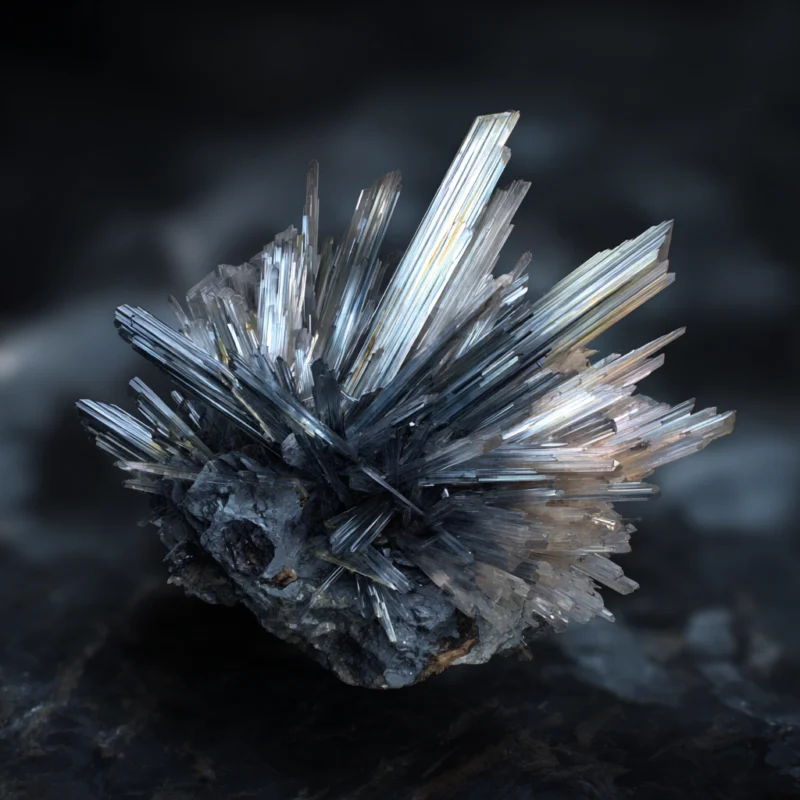
Image by Midjourney.com
Historical and Cultural Significance
Stibnite’s legacy reaches back thousands of years, making it one of the earliest minerals intentionally mined and processed by humans. In ancient civilizations, finely ground stibnite was used to produce kohl, a dark cosmetic applied around the eyes. In ancient Egypt, this practice was both aesthetic and spiritual. Kohl was believed to invoke the protection of the gods, particularly Horus and Ra, and was thought to shield the wearer from the sun’s glare, windblown sand, and eye infections. Archaeological evidence shows that stibnite-based cosmetics were used by people of all social classes, from royalty to laborers.
The use of stibnite as an eye cosmetic spread widely across the ancient world, including Mesopotamia, Greece, Rome, and the Islamic world. Beyond its visual appeal, many cultures believed stibnite had protective or healing properties, capable of warding off illness and evil spirits. While modern science recognizes the toxicity of antimony compounds, trace antimicrobial effects may help explain why these practices persisted for so long.
During the Middle Ages and early modern period, stibnite took on a new role as the primary source of antimony for alchemy and early medicine. Alchemists were fascinated by antimony’s unusual properties, viewing it as a substance that blurred the line between metal and mineral. Antimony compounds were prescribed to treat a wide range of ailments, including parasitic infections, fevers, and digestive disorders. These treatments were controversial, sometimes dangerous, and frequently debated within medical circles.
Antimony became so closely associated with monastic medicine that it earned the nickname “the monk’s metal.” Monks and apothecaries experimented with antimony-based remedies, believing that its powerful effects—both beneficial and harmful—reflected its ability to purify the body. One infamous example was the use of antimony cups, from which wine was drunk to induce vomiting or purging, a practice intended to cleanse the body of illness.
By the 17th and 18th centuries, growing scientific understanding led to more cautious use of antimony, and its role gradually shifted from medicine toward metallurgy and industry. Even so, the long and sometimes perilous history of stibnite in cosmetics and medicine underscores its profound influence on human culture. Few minerals can claim such a direct connection to daily life, spirituality, healing, and experimentation across so many civilizations and centuries.
Today, stibnite’s importance lies primarily in its role as the chief ore of antimony, which is extracted and refined for modern applications. Antimony is used in:
- Flame retardants
- Lead-antimony alloys for batteries
- Semiconductors and electronics
- Pigments and glass production
- Ammunition and military applications
Although collectors prize intact crystals, most stibnite mined worldwide is processed for its antimony content rather than preserved as specimens.
As a collector’s mineral, stibnite has long had a cult following for its cool, sleek, gunmetal coloration, high capacity for luster, and its potential for extremely aesthetic, sculptural clustering. It was long believed that the finest stibnite had all been found by the early 1900s from the Ichinokawa mine in Japan, but an incredible discovery nearly a century later rivaled the Japanese examples in quality, and thoroughly eclipsed the iconic relics in size, proving themselves to be the new standard. Although Japanese material is still admired for its unique bluish patina and is revered as an old-world classic, Chinese stibnite from the Wuning (also, “Wuling”) mine, discovered in 2005, is considered a modern classic and the best known to date.
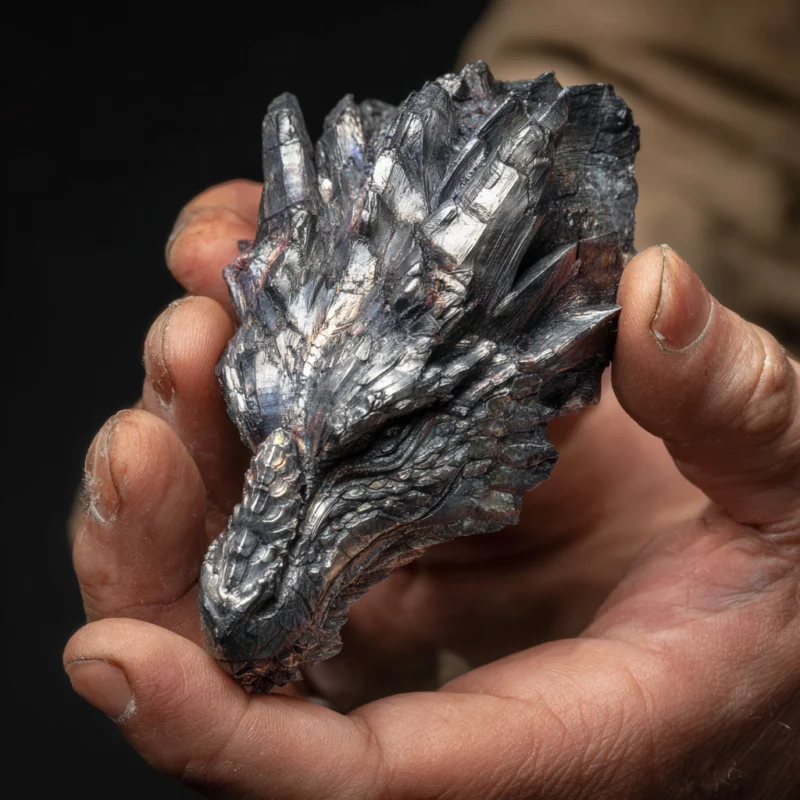
Image by Midjourney.com
https://www.mardanifineminerals.com/blog/2017/09/21/stibnite-00582/
https://dakotastones.com/blogs/news/how-gemstones-have-been-used-to-ward-off-spirits
https://www.fossilera.com/pages/stibnite-the-metallic-mineral-that-shaped-medicine-warfare-beauty