
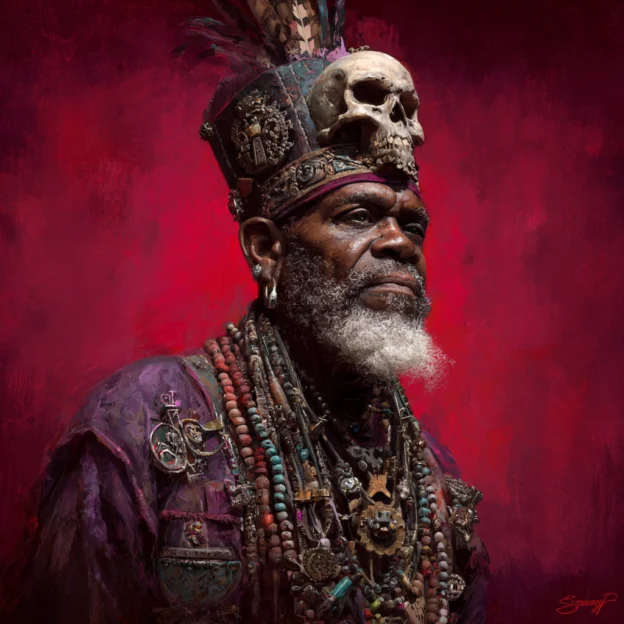
Image by Midjourney.com
Voodoo is a religion.
Hoodoo is a spiritual and magical practice.
Voodoo originated in West Africa, while Hoodoo began in the United States.
Hoodoo (not to be confused with Voudou) is a spiritual religious tradition created by enslaved African Americans in the United States and inspired by Central and West African religious practices. The practices include herbal healing, veneration of African ancestors, counterclockwise circle dancing (Ring Shout), water immersion, sacred music, spirit possession, divination, and using charms for spiritual protection against physical harm and conjure. Many of these Central and West African religious practices were brought to North America during the transatlantic slave trade. Enslaved Africans were often forced to become Christians upon arrival in North America. The synchronization of African practices with the Christian religion created Hoodoo among enslaved African Americans. Slave codes did not allow large gatherings of free or enslaved Blacks, and it was a crime for African Americans to practice traditions from Africa. As a result, some Hoodoo practices were hidden in African American churches, creating a unique brand of Christianity that fused African traditions that was called Afro-Christianity, or African American Christianity. The Hoodoo religion during slavery included religious practices from various African cultural groups, including the Odinani religion of the Igbo people, the Yoruba and Vodun religions of the Fon and Ewe people, and a Bantu-Kongo tradition in Central Africa. All these African religious traditions blended and fused with Christianity on slave plantations, creating a unique spiritual tradition practice by enslaved African Americans and their descendants. After the Civil War, many of these African religious practices survived in Hoodoo and became a spiritual practice that continues in African American communities today.
During slavery, the words “conjure” and “Voudoo” were used to describe the conjure practices of enslaved and free blacks. Hoodoo practices documented by former slaves will describe Hoodoo as either conjure or Voudoo. The earliest known use of the word Hoodoo to describe African American conjure was around 1870 in a book titled Seership the Magnetic Mirror, written by Black American occultist Paschal Beverly Randolph. Randolph believed the word Hoodoo derived from an African dialect, because he traveled to Africa and studied African religions. Today in the African American community, Hoodoo is known by other names such as root work and conjure.
William Wells Brown (circa 1814-1884) was a formerly enslaved man and an abolitionist who documented Hoodoo practices of enslaved people in St. Louis in two of his books. Brown was born enslaved in Kentucky. In 1827 Brown’s enslaver, Dr. John Young, moved near St. Louis, Missouri, and established a small farm. Dr. Young hired out Brown to work in the city of St. Louis for steamboat captains and local merchants. During his years enslaved in St. Louis, Brown saw conjure practices of enslaved people that he documented years later in his autobiographies after he escaped from slavery on the Underground Railroad.
Brown wrote:
“I should have stated, that, before leaving St. Louis, I went to an old man named Frank, a slave, owned by a Mr. Sarpee. This old man was very distinguished (not only among the slave population, but also the whites) as a fortune-teller….I found Uncle Frank seated in the chimney corner, about ten o’clock at night. As soon as I entered, the old man left his seat. I watched his movement as well as I could by the dim light of the fire. He soon lit a lamp, and coming up, looked me full in the face, saying, ‘Well, my son, you have come to get uncle to tell your fortune, have you?’ ‘Yes,’ said I. But how the old man should know what I came for, I could not tell. However, I paid the fee of twenty-five cents, and he commenced by looking into a gourd, filled with water. Whether the old man was a prophet, or the son of a prophet, I cannot say; but there is one thing certain, many of his predictions were verified. I am no believer in soothsaying; yet I am sometimes at a loss to know how Uncle Frank could tell so accurately what would occur in the future. Among the many things he told was one which was enough to pay me for all the trouble of hunting him up. It was that I should be free! He further said, that in trying to get my liberty I would meet with many severe trials. I thought to myself any fool could tell me that!” 1
Voodooists worship Bondye and spirits called loa. Voodoo practitioners believe in a higher being called Bondye and many spirits called loa (also spelled lwa). The loa influence different areas of life, such as agriculture and love. Worshippers believe that loa can interfere with human affairs and even possess people’s bodies. While possession might sound scary, voodooists actually desire and value possession by loa! Practitioners see it as an important spiritual experience that can bring you closer to the spirit world. The loa serve as a go-between for Voodoo followers and Bondye, who does not interfere with human affairs. For example, Papa Legba is the loa of the spiritual crossroads, or the barrier between humans and the spirit world. He often appears as an old man with a cane and a dog.
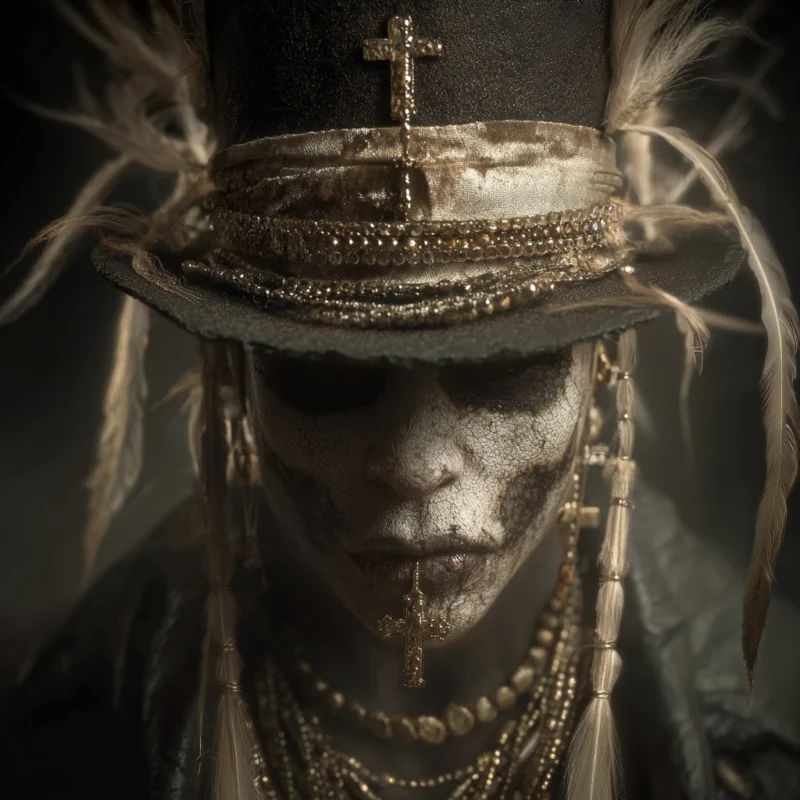
Image by Midjourney.com
Voodoo involves spiritual ceremonies to invoke loa. Voodoo religious ceremonies take place in private settings in Africa, Haiti, and various parts of the United States. Ceremonies are high-energy and involve singing, dancing, and drumming.hese rituals invite the loa to possess, or “mount,” a participant, allowing for communication between spirits and humans For example, the Haitian Rara Festival is a street procession linked to the agricultural cycle. It is dedicated to Gede, the group of loa in control of death and fertility.
Hoodoo focuses on ancestor worship. A large part of Hoodoo practice is ancestral worship, which stems from Hoodoo’s origins in the Atlantic Slave Trade. Enslaved African Americans would perform rituals that drew inspiration from Voodoo to honor and feel closer to their ancestors. Modern ancestor worship can involve home altars with photos, relics, or anything that makes you feel connected to your ancestors.
Hoodoo practitioners use conjure for healing and good fortune. Conjure and rootwork are spiritual practices that use objects like herbs and roots. These practices can allow you to retrieve lost objects, predict the future, or bring about good fortune. For example, John the Conqueror Root can bring good luck. Hoodoo practitioners may use it in rituals to draw strength, power, and good fortune. Today, many Hoodoo practitioners use conjure practices to continue honoring their ancestors and engage in spiritual healing. This might include performing ceremonial dances called ring shouts, or tending to the dead with herbs, tobacco, and sacred plants.
GET OVER IT!
Mainstream media misrepresents Voodoo and Hoodoo as dark or evil. Unfortunately, popular media tends to portray African spiritual practices like Hoodoo and Voodoo in a bad light. But neither practice is evil! You might associate the words Hoodoo and Voodoo with Voodoo dolls, zombies, or Hollywood representations of “black magic.” However, these are misrepresentations of how practitioners engage in their rituals and beliefs. After the success of the Haitian Revolution, European and American colonies felt threatened by Hoodoo and Voodoo as a source of power. This led them to demonize both practices.
Hoodoo and Voodoo are distinct from witchcraft. While you may be tempted to group these spiritual practices in with our modern understanding of witchcraft, they are not the same! Witchcraft was once thought of as a magical practice used to harm people, but it’s actually a neo-pagan practice in which practitioners focus on themselves, the earth, and animalistic spirits. Sometimes, the word “witchcraft” is used to refer to the Wiccan religion, which is centered around honoring the Goddess and the natural world. Neither of these practices is the same as Hoodoo or Voodoo. African mythology experts Adwoa Botchey and Solomon Adebiyi at Adeche Atelier explain, “The term witch wasn’t really used in [African] contexts. It was more of a Western world word that was taken and brought to the continent during slavery.” Babalawo, Sangoma, and Akomfo are examples of African spiritual figures you might compare to a witch. However, Adeche Atelier distinguishes these figures as herbalists who can offer healing and guidance. 2
1 https://www.nps.gov/articles/000/hoodoo-in-st-louis-an-african-american-religious-tradition.htm
2 Adeche Atelier, Samantha Fulton BA, – https://www.wikihow.com/Hoodoo-Voodoo-Difference
GOOD EXAMPLE OF HOW HOLLYWOOD TAKES ADVANTAGE OF BELIEF SYSTEMS.