
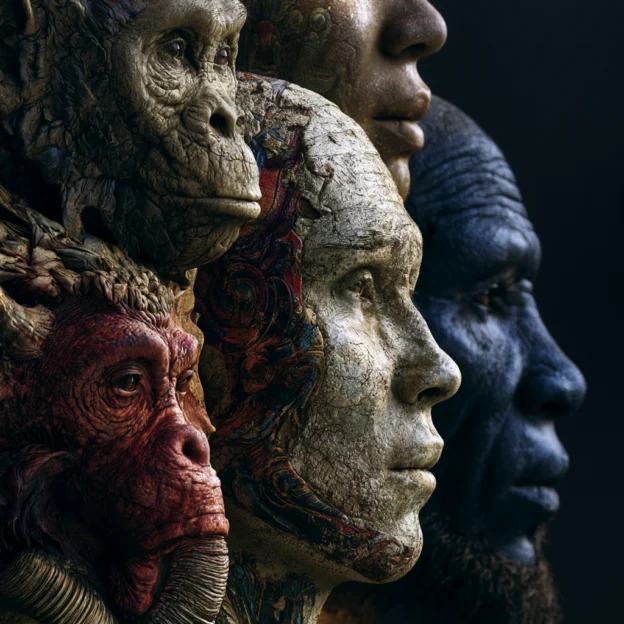
Image by Midjourney.com
We humans think we are the pinnacle of evolution – the most advanced creatures on the world with our opposable thumbs and our culture of manmade fidget spinners. Now that we’ve mastered this, where is there left to go? What’s in store for the future of human evolution?
History
Homo sapiens first appeared on the scene about 200,000 years ago and modern human culture has endured for at least the last fifty thousand years. In that time our physical appearances haven’t changed very much but that’s not really surprising because evolution is a gradual process and the geological record shows that new species often take up to a million years to get going. A million years ago in human history homo erectus had long discovered fire but hadn’t yet used it to cook food. Everyone loves our salad, right? I’m sure homo erectus did so what about the next million years?
Well, there’s no shortage of speculation –

Image by Midjourney.com
Speculation
From the realms of science fiction you’ve got the H.G. Wells prediction of subterranean goblin like Morlocks and passively elegant Eloy OR how about populations of superpower wielding mutants or even the worryingly portentous fate of space bound humans in warning. But little of these speculations are based in fact and providing we don’t wipe ourselves out any changes are likely to be a lot more subtle. In fact some people think there won’t be any changes at all. According to Darwin’s theory of evolution by natural selection, any changes come about as a result of natural variations in an existing population that turn out to be a helpful bonus for survival in their chosen environment. Take our opposable thumbs for instance – nifty little things good for grabbing and manipulating things. We’ve all got them because way back when one of our ancestors was born with a slightly more mobile thumb by chance being able to grab onto things and manipulate them a bit better. This was good news for its survival and then it lived a long and happy life and had lots of babies.
Modern Humans
Over time this Wiggly thumb gave the advantage over eight non wiggly thumb and the more primitive version gradually disappeared. While the new model became what we have today (that’s natural selection in a competitive world, thank goodness) because how could you text? The theory goes that this natural selection isn’t really working for us modern humans anymore. Without technology and our big problem solving brains we are finding ways of overcoming many of the challenges that nature puts in our way.

Image by Midjourney.com
Human Evolution
Without necessarily resorting to survival of the fittest if we were faced with the same need for a wiggly thumb. Today we could probably make a machine that could fulfill that need. We humans could just stay the same not changing not evolving. It’s a compelling idea but it’s probably not true. Even in the relatively short time that humans have been around some changes have been found. For instance. about ten thousand years ago we developed a tolerance to lactose allowing us to drink milk to supplement our diet and in the last hundred and fifty years the average adult height has increased by ten centimeters not only that but the age at which women have children is slowly creeping up and we’re gradually developing resistances to diseases like malaria and HIV.
Future Changes
So changes are taking place but it’s a slow business and it’s likely that when combined with the technological taming of the world around, people a million years from now will simply look healthier longer living versions of ourselves. We could however speed it up by dabbling in a bit of genetic engineering choosing desirable disease-free embryos or physically changing a human’s genetic code but since our understanding of the human genome is still vastly incomplete the possibilities for future changes are far too numerous to consider here.
Crossbreeding
So, let’s assume we’re stuck with natural change over a long period of time. One of the reasons it would take such a long time to see any big changes in human characteristics is the sheer amount of crossbreeding we do for most animals. Simply living on opposite sides of a river could put a dampener on any romantic note leading to the isolation of two different populations. Quicker evolution is different groups going their own separate ways but many of us humans wouldn’t think twice about getting on a plane to sustain a long-distance relationship. This globalization means that pretty much all seven and a half billion of us inhabit the same gene pool. So it’s gonna take a long time for any changes to ripple out across the whole pool and evolution to take place. Given a million years though it’s conceivable that we will find a way to isolate small populations in potentially stressful environments like in space. Send up ships of colonists to a world with less oxygen or lower gravity or one that’s covered in ice. Then you’ve got yourself all the ingredients for major physical change. Giggling with a thin atmosphere could lead to humans with red blood cells that can stuff way more oxygen in like people who live in the Andes today or who breathe much faster than we do and have wider blood vessels like the modern Tibetans. .IF gravity was lower like on Mars or the moon humans could grow taller with longer arms and legs and would likely develop new ways of getting around and that would change the structure of the muscles in their bodies. On an ice world we could see the return of insulating body hair and fat and even a change in our body clocks to encourage hibernation through the coldest times. – Video Transcript
“Predicting out a million years is pure speculation, but predicting into the more immediate future is certainly possible using bioinformatics by combining what is known about genetic variation now with models of demographic change going forward. All the migration comes from rural areas into cities so you get an increase in genetic diversity in cities and a decrease in rural areas. It’s almost certainly the case that dark skin colour is increasing in frequency on a global scale relative to light skin colour. I’d expect that the average person several generations out from now will have darker skin colour than they do now.” – Dr. Jason A. Hodgson, Lecturer, Grand Challenges in Ecosystems and the Environment.