
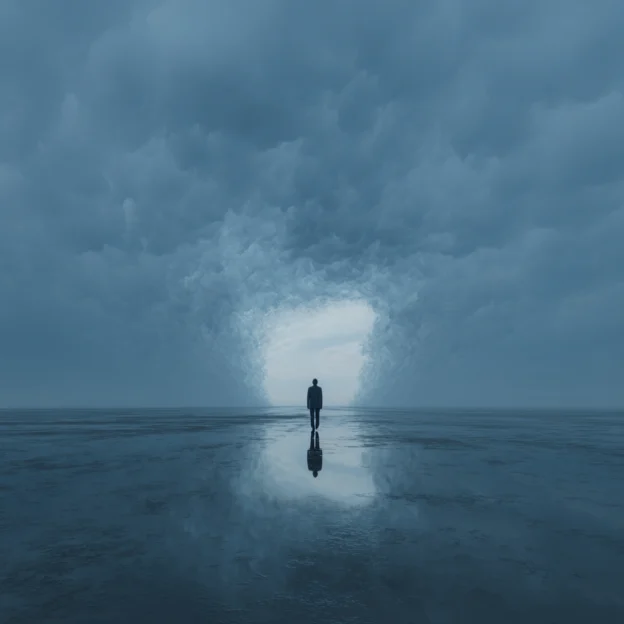
Image by Midjourney.com
The term Bardo originates from the Tibetan Book of the Dead Bardo Tödröl – where Bardo means “the temporary” and Tödröl means “liberation.” The title can be translated as “liberation through listening in the intermediate state.”
When death occurs, the soul – along with parts of the energy system from physical life – is accompanied by death angels into the intermediate realm. In this temporary state, the soul’s primary task is to process, understand, and reconcile with its actions and experiences from the incarnation that has just ended.
This integration phase typically lasts from several weeks to two-three months but can become significantly longer in cases where the soul carries intense fear or particular karmic burdens.
It is entirely possible to communicate with souls in Bardo – and they can also communicate with us when conditions are favorable. Once the process of acceptance and integration is complete, the soul can turn again to the death angels, who then guide it further on the final stage of the journey toward the Realm of Light and the next life.
In the Realm of Light, we reunite with our soul, our soul family members, and our spiritual guides. Here, the soul engages in a profound planning process together with selected members of its soul family and special light beings who serve as guides. Together, they design the blueprint for our next incarnation: the learning experiences we will undergo, the challenges we will face, and the life path that best supports our current phase in the incarnation cycle.
When the time is ripe for a new incarnation/dream, the soul consciously seeks the setting that will best support its purpose and learning tasks in the upcoming life. In other words: as souls, we choose our parents. This choice is often guided by our karmic flow in relation to the soul’s learning themes and our meta-incarnation cycle.
The greatest challenge at the moment of death is the fear of the unknown. When this fear dominates, the soul can become “trapped” in Bardo and create its own anxiety-filled state – a self-constructed hell shaped by unresolved conflicts, grief, and unprocessed life experiences. If one avoids confronting what is happening in the present moment, or what has occurred in the life being left behind, the soul may remain in a kind of timeless paralysis in the intermediate realm.
I have assisted souls who have been bound to Bardo for several decades – and in some cases much longer. Often, these souls attempt to seek out power places or locations with strong energy, hoping that someone with the right expertise can help them move forward. When working with clients seeking support during the transition between life and death, I collaborate closely with death angels and the client’s own soul to ensure a peaceful and smooth transition. This is also why I recommend that every family has at least one well-trained shaman in their circle – someone who can safely welcome new souls and guide them forward when the time of transition approaches.
Ghosts are, in essence, deceased individuals who remain in the Bardo state. Sometimes, people who die have difficulty letting go of their physical existence – an attachment that binds them to the material world longer than necessary.
The reasons for this can be numerous. Some cling to their homes, partners, or children. Others harbor a strong need to control their surviving loved ones or carry a deep fear that their beloved ones won’t manage without them. In some cases, the grief over losing their closest relatives becomes so intense that it prevents the soul from moving forward toward the Realm of Light.
As long as a departed soul remains in the transitional state of Bardo, communication is possible – provided one has the proper training and experience. However, a crucial question must always be asked: Why do we truly wish to contact the deceased? Wouldn’t it be more compassionate to grant them the peace they need to complete their journey and transition to the Realm of Light, where they can find true rest and tranquility?
The stronger our emotional need to hold onto those who have passed, the more challenging we make their transition. When the deceased witness our grief and pain, it can be so overwhelming for them that they choose to remain behind in an attempt to comfort and support us – even though they no longer have the ability to ease our suffering. The grieving process is ours to bear, and no departed soul can complete it for us.
It’s crucial to understand that their time in the physical world has concluded, and our inability to let go can prevent them from moving forward. Even when death comes suddenly or under traumatic circumstances, we must undergo our own grieving process – an inner journey that fundamentally involves letting go – so that both we and the departed can be liberated. Only then can the soul conclude its stay in Bardo.
– https://www.wanvig.no/en/the-secrets-behind-death-and-reincarnation-what-happens-after-death/