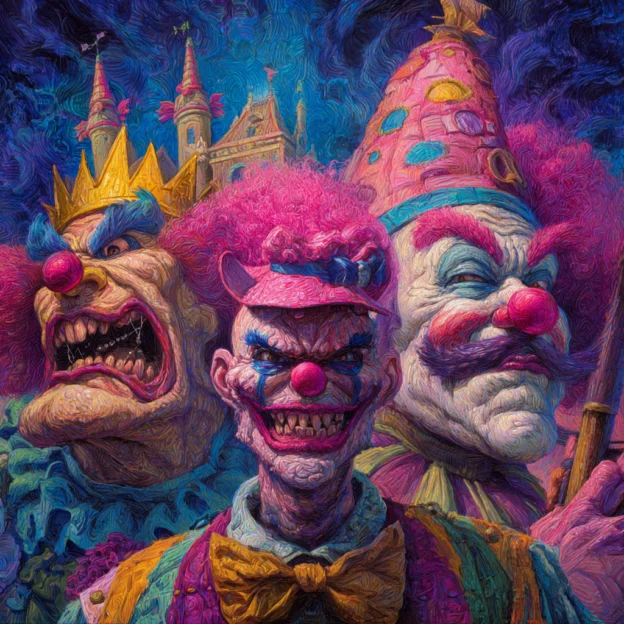
1. The Psychology of Coulrophobia
- Hidden Intentions: Humans rely on facial micro-expressions to determine if someone is a threat. Clown makeup permanently freezes a happy or sad expression, completely hiding the alien’s true, harmful intent.
- Perceptual Dissonance: Our brains are wired to associate clowns with fun and safety. When those figures act with malice, the resulting emotional shock is far more jarring than a traditional horror monster, causing deep psychological unease.
2. Absurdist Humor as a Coping Mechanism
The film embraces absurdist horror. The killers do not use conventional weaponry like lasers or guns; instead, they use oversized mallets, shadow puppets, and acid-filled pies.
- Play as Violence: The aliens view torturing and killing humans as a game. In one particularly dark scene, an alien uses a human corpse as a ventriloquist dummy, mocking the victim’s partner. This transforms the movie into a dark satire of slapstick comedy itself.
- Detached Lethality: By turning horrific deaths into bright, colorful circus acts, the film forces the viewer to process two conflicting emotions simultaneously: humor and horror.
3. The Danger of Dismissing the Ridiculous
The movie heavily satirizes the trope of the “incompetent adult authority figure.”
- Refusal to Believe: When teenagers and young adults try to warn the police about the aliens, the authorities (specifically Officer Mooney) refuse to take them seriously because the threats are disguised as clowns.
- Cognitive Inertia: This mirrors real-world psychology, where humans tend to ignore warnings or reality-breaking information simply because it falls outside their conventional worldview or comfort zone.
4. The Ancient Alien Theory
In the lore of the film, the clown-like aliens periodically invade Earth to harvest humans. One popular fan theory suggests that human culture’s creation of clowns is actually a distorted, ancient psychological coping mechanism. According to this concept, early humans encountered these harvesters, and the fear was so deeply ingrained in our species that it evolved into a cultural memory, manifesting as the traditional circus clown over hundreds of years.
Do you have a fondness for old 50s B movies?
This film is a parody of the sci-fi/horror/monster movie genre that was extraordinarily popular during the 1950s; films like “The Blob” (1958), “Invasion of the Body Snatchers” (1956), “The Beast from 20,000 Fathoms” (1953), or “The Day the Earth Stood Still” (1951). Movies like that have a certain charm- it’s like slipping into a comfortably creepy atmosphere for a short time, and then return to the real world.
As this film is a parody of 1950’s b-movies, many of the characters are all tropes of those kinds of pictures. Our main characters, Mike Tobacco (Grant Cramer, “Lone Survivor”) and Debbie Stone (Suzanne Snyder, “Return of the Living Dead Part II”), are two high school students on their first date. Mike behaves like a typical high school movie jock, and Suzanne behaves like a typical high school movie cheerleader. Other main characters include Curtis Mooney (John Vernon, “Dirty Harry”), the incomprehensibly dense town Sherriff, and his younger, less experienced partner Dave Hansen (John Allen Nelson, “Deathstalker and the Warriors from Hell”). There are also the eccentric Terenzi brothers (Michael S Siegel, Peter Licassi), who operate an ice cream truck. The characters play their roles like they were caught in a rerun of an old Twilight Zone episode. Their reactions are overblown, their cadence feels forced, and their dialogue is laughably dated- but that’s entirely the point and it works wonders for this film. Honestly, I think my favorite part of this film was how much it really played into those tropes. The Sherriff is needlessly obtuse, to the point where its so ridiculous that it becomes comical, and the other characters all seem to play into their roles as well.
While I really appreciated a lot of the scenes in this film, there were others that I wasn’t sure what emotion the director wanted me to feel. As this is a horror comedy, I expect there to be both laughs and thrills, and this film does provide both, but there are some scenes when the authorial intent is not at all obvious. Am I supposed to be scared or laughing at this scene? There are other horror comedies that flit between the two genres much better- take “Shaun of the Dead” for instance. In “SotD”, we have scenes that are very clearly supposed to be emotional moments, and other scenes that are very clearly supposed to be funny. Edgar Wright does a great job of differentiating what I’m supposed to be feeling and when, so even though the film has moments of hilarity, and moments of terror, it feels even and balanced throughout the film, and I come out of that movie fully satisfied with what I’ve seen. In this film, there were a few scenes that bordered on funny, but weren’t funny enough to make me laugh, while at the same time they were showing me images that were creepy looking, but not creepy enough to make me squeamish. As a result, some of those scenes felt incredibly flat, and it made moments of the movie drag and others feel meaningless. On one hand, it’s a stroke of genius: a shameless, low-budget sci-fi comedy with humor as black as pitch, a film that screams “It’s the 80s!” with a voice that has echoed through the decades. On the other hand, it digs its garish klown-claws deep into our most primal childhood fears. It weaponizes the familiar figure of a clown with such a ruthless and sinister glee that it could make Pennywise and Art the Clown sit up and take notes, arguably helping to perfect the evil clown subgenre of horror.
There’s a word for the fear of clowns: coulrophobia. Interestingly, the term originally described an irrational “fear of people walking on stilts” but is now almost exclusively used to describe a fear of clowns. This is a fear rooted in genuine psychological reasons, and it’s only increasing, likely due to their growing presence in pop culture’s horror genre. With studies showing that more than 50% of people have a fear of clowns to some degree—and 5% admitting to an “extreme fear”—it’s no wonder these colorful circus performers continue to haunt our screens and our nightmares.
But this always led me to a question: why didn’t other clown horror movies scare me in the same way? Why didn’t Pennywise from Stephen King’s IT (perhaps my favorite of his novels) have the same visceral effect, even with Tim Curry’s brilliant portrayal in the 1990 miniseries? I love that story—and the later cinematic versions of 2017 and 2019—but it’s a different beast entirely, playing on deeper childhood fears and cosmic horror in a way that Killer Klowns from Outer Space simply doesn’t.
Maybe it was their inhumanity, their sheer alienness. And the fact that they never talk. At least not any language we can understand. That quality tapped into my childhood fear of UFO abductions, creating a perfect balance of terror that Pennywise, brilliant as he was, never quite matched. Different beasts, indeed.
Remember, this film has been a cult classic for thirty years now, and with all of your favorites from the circus, cotton candy, balloons, pies, big feet, red noses and death all over the place, it is hard to find a reason not to watch this movie. Stay Scared.