
Derivative Images
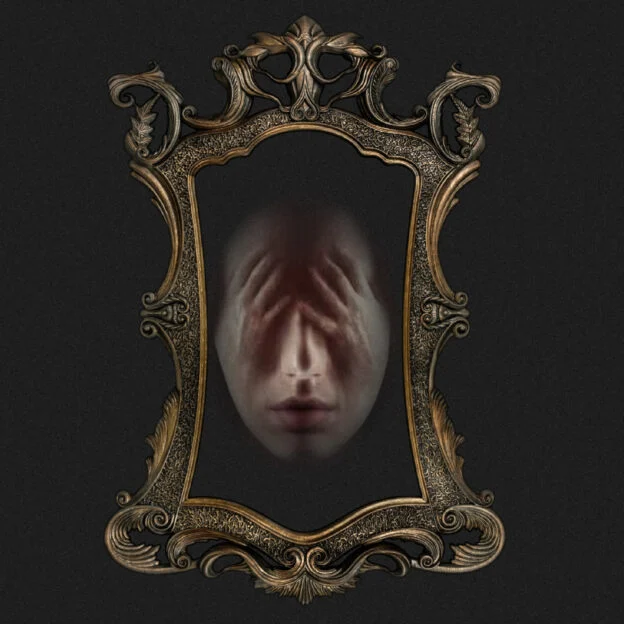
Oculus is a 2013 American supernatural psychological horror film co-written, edited, and directed by Mike Flanagan. The film takes place in two different times: the present and 11 years earlier. The two plot lines are told in parallel through flashbacks. It is basically a haunted object story about the Lassar Glass. For over 400 years, it has manipulated and driven its owners to insanity, resulting in dozens of grisly murders and suicides. The mirror is a 400-year-old antique framed in Bavarian black cedar. It does not have a physical body, but its glass contains a malevolent entity that feeds on human perception. It projects extreme, vivid hallucinations into the minds of those around it. Victims lose their sense of time, mistake their own family members for monsters, and forget to eat or drink.
Oculus of glass, I stare. I can feel you staring back. I hear your voice, believe your lies. A window, portal, darkened door. Should you claim my staring eyes, my soul you hold forevermore. – Legend of the Lassar Glass
Victims of the Lassar Glass History
1754: Philip and Virginia Lasser – The 17th Earl of Leicester. The first known owner of the mirror and namesake. Phillip Lasser hung it over his fireplace in his London estate where he and his wife Virginia resides. He is later found burnt to death at the base of fireplace. He later seen in the mirror by servants and a church investigation is warranted on the estate.
1864: Robert Clancy – Southern railroad tycoon who was know as the South Windham Whale in college due to weighting 300 pounds. He hung the mirror in his Atlanta, GA ballroom. He lost a dangerous amount of weight and died a few weeks later.
1904: Mary O’Connor – A woman from New England who hung the mirror in her private bathroom. She was found dead two weeks later in her bathtub full of water from dehydration by her niece, Beatrice.
1943: Alice Carden – Lake Geneva, WI. She hung the mirror in her children’s nursery of their farmhouse. She drowned her two children thinking she was putting them to bed and smashed her bones with a hammer in children’s nursery. Her australian shepherd dogs vanished and are never found.
1955: Tobin Capp – Starved to death in his bedroom where he had the mirror hung. His pet dalmatian is never located and his house plants are also dead.
1965: Maria Wicker – Bank Teller in San Diego, California. The mirror hung in the lobby of Hill Trust Bank where she worked. Maria locked the manager in the vault and chewed through a live power line. The plants in the bank also have died.
1971: Oliver Jeffries – A teacher at Duhame Academy in New York City. His classroom plants died and he tried to break the mirror with a fire poker which hung in the central lecture hall. He stopped in front of mirror and stood in front of it before walking out of the hall into traffic and was hit by a car.
1975: Marisol Chavez – Dies from hemorrhaging from a miscarriage in her bedroom where the mirror was hanging. She had pulled out all her teeth with a pair of pliers and put them in a plastic bag.
2002: Alan And Marie Russell – Alan hung the mirror in his home office. Their house plants die off and the family’s golden retriever Mason vanishes. Within two weeks Maire suffers a nervous breakdown and is tortured and shot to death by her husband who also tried to kill his son and daughter before Alan forces his son to shot him in front of the mirror. The mirror is cracked in the lower right corner.
2013: Michael Dumont and Kaylie Russell – Michael is about to have his auction house sell the mirror but his fiance’ Kaylie, Alan and Marie’s daughter, attempts to prove the mirror’s evilness before destroying it. Michael is stabbed in neck by Kaylie after mistaken him for her mother’s ghost. Kaylie, who was standing in front it thinking she saw her mother is impale by anchor that was a booby trap for mirror by her brother, Tim. – https://evil.fandom.com/wiki/Lasser_Glass
The film alternates between the past and present, switching between scenes from the childhood of Kaylie (Karen Gillan) and Tim Russell (Brenton Thwaites) and the modern day, where Tim has been released from a psychiatric hospital. In the early 2000s, Kaylie and Tim’s parents, Marie and Alan, had moved them to a new house. Alan, a software developer who worked from home, bought a large, antique mirror to decorate his office, but it soon begins to behave strangely. Unbeknownst to them, the mirror supernaturally induces hallucinations. Marie is haunted by visions of her own body decaying, while Alan is seduced by a mysterious and ghostly woman named Marisol Chavez who has mirrors in place of eyes.
Often voices are heard from the room, and the siblings see strange people in the office. More and more details are revealed, but it’s clear from the beginning that the mirror will eventually drive Marie and Alan insane, leaving Kaylie and Tim as orphans.
Several years later, Kaylie researches the mirror’s origin and its gruesome history, determined to prove that her parents were actually possessed by something and not just partners in an unhappy marriage. Tim joins her as she sets up cameras, thermometers, and a fail safe to destroy the mirror in case anything goes wrong. However, the mirror soon starts to play games with them, causing realistic hallucinations of their childhood and deaths of loved ones.
Oculus frequently finds itself presenting conflicting versions of the events that took place leading up to the family’s tragedy. Memory, it turns out, isn’t always the most reliable recordkeeper when it comes to traumatic events. What’s more, the mirror appears able to present conflicting versions of current events, as well. Several times throughout the film, Kaylie and Tim find themselves hallucinating objects, movements, and even each other, even when not reliving their trauma through vivid flashbacks. The scariest part is that the mirror’s influence seems to be absolute—Kaylie’s belief that technology might be used as a filter through which to pierce the mirror’s illusions is roundly shattered, as are attempts to escape the mirror’s reach by leaving the house.
Although Kaylie’s goal is a noble one, the mirror’s tricks prove that she, at best, fails to understand the limits of its power and, at worst, is willfully ignorant of her own untreated illness which the mirror represents.
-
- Memory Distortion: The film cuts back and forth between the siblings’ harrowing childhood and their adult return to the mirror. As the Lasser Glass manipulates them, the distinction between past events and present reality dissolves, mimicking the fragmented nature of Post-Traumatic Stress Disorder (PTSD).
- Dueling Perspectives: The sister, Kaylie, relies on her research and technology to prove a supernatural truth. The brother, Tim, relies on years of institutional psychiatric therapy, initially viewing their past entirely as folie à deux (shared madness) and repressed trauma. This constantly forces the audience to question if the mirror is actually alive, or if the siblings are projecting their deteriorating mental states onto it to cope.
- Parental Breakdown: As children, the siblings watch their parents slowly lose their minds under the influence of the mirror. The mother spirals into deep paranoia and maternal neglect, while the father becomes sadistic and abusive.
- The Cycle of Trauma: The siblings, specifically Kaylie, exhibit an obsessive, self-destructive desire to control and understand the trauma. They take on the traits of their parents—Kaylie becomes obsessively controlling (like her mother), while Tim represents logical skepticism (like his father).
Why Does the movie bother people so much?
Basically, the movie deeply unsettles audiences because it creates a constant, inescapable feeling of paranoia. Rather than relying on simple jump scares, it disorients viewers by blurring the line between reality and hallucination, leaving you unable to trust what the characters are actually seeing or experiencing. The point of the supernatural psychological horror movie Oculus is to explore the devastating, inescapable nature of trauma. Through a haunted antique mirror, the film illustrates how unresolved grief and obsession can warp perception, shatter a family, and cause reality to bleed into madness.
Oculus is a film that an awful lot to say about how we manage our own pain and how we, at times, mistakenly interpret having lived through trauma as meaning we are the only ones equipped to successfully navigate it—particularly when the trauma was a shared one to begin with. Solutions and healing rarely come in black and white, and rarer still is the opportunity to erase a past wrong. In most cases, acceptance and reconciliation are the better, healthier ways of dealing with your skeletons—or your mirrors. – Ande Thomas – https://www.whatsleepsbeneath.com/archive/oculus-review
https://en.wikipedia.org/wiki/Oculus_(film)
https://evil.fandom.com/wiki/Lasser_Glass
https://www.whatsleepsbeneath.com/archive/oculus-review
https://thecampoclaw.com/lifestyle/2014/04/23/oculus-creepy-confusing-terror/