
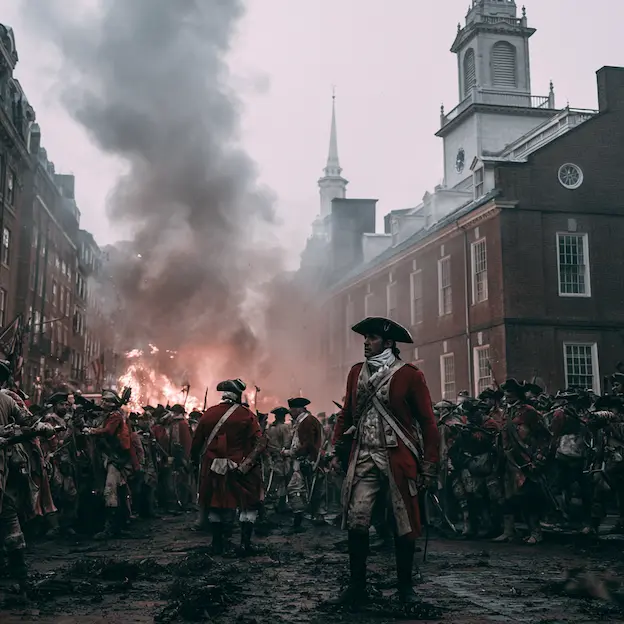
Image by Midjourney.com
On the frigid evening of March 5, 1770, the cobblestone streets of Boston, Massachusetts, became the stage for an event that would irrevocably alter the course of American history. Tensions between the American colonists and the occupying British soldiers had been simmering for months, fueled by heavy taxation and the oppressive presence of the Crown’s troops. What began as a minor dispute outside the Custom House on King Street quickly escalated into a chaotic and deadly confrontation.
The Boston Massacre of 1770, as it came to be known, served as a bloody catalyst that united the colonies and laid the groundwork for the American Revolution. This pivotal moment in history galvanized the patriot cause and left a dark, lingering imprint on the city. Centuries later, the echoes of that fateful night continue to resonate. Chilling tales of restless spirits and unearthly occurrences remain tied to the very spots where history was violently written.
Who Was Killed During the Boston Massacre?
The tragic events of March 5, 1770, claimed the lives of five men. Their deaths became a rallying cry for the patriots, turning these individuals into the first martyrs of the American Revolution. The victims of the Boston Massacre include:
- Crispus Attucks
- Samuel Gray
- James Caldwell
- Samuel Maverick
- Patrick Carr
Unsurprisingly, these tragic figures are said to be the shadows that linger in front of the old British Custom House.
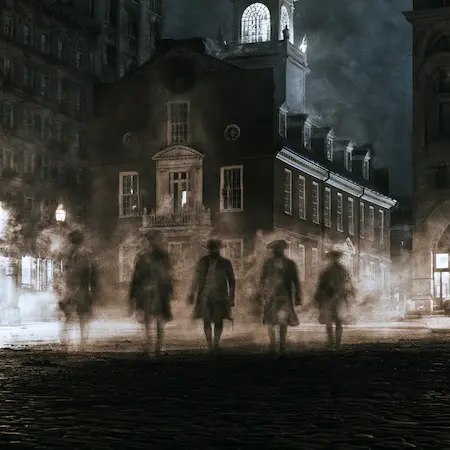
Image by Midjourney.com
The Townshend Acts of 1767
Named after Charles Townshend, the Chancellor of the Exchequer, the Townshend Acts of 1767 placed import duties on essential commodities shipped to the American colonies. Essentially, these included glass, lead, paint, paper, and tea.
Unlike the Stamp Act of 1765, which was an internal tax, the Townshend Acts were external taxes on trade. However, the colonists quickly recognized the underlying intent. The Crow was going to use the revenue to pay the salaries of colonial governors and judges.
By securing financial independence for Crown officials, Parliament effectively weakened local self-governance.
Indeed, the response throughout the colonies was swift and highly coordinated. Merchants in Boston, New York, and Philadelphia established non-importation agreements, pledging to boycott British goods until the offensive duties were repealed.
Citizens took up the cause with fervor, turning the refusal of British imports into a badge of patriotism. Writers like John Dickinson of Pennsylvania galvanized public opinion. Using widely circulated publications, he argued that any tax imposed without the consent of elected representatives violated the fundamental rights of Englishmen.
Political groups like the Sons of Liberty actively policed the boycotts, publicly shaming merchants who defied the agreements. They also organized massive protests that frequently disrupted local commerce.
As the boycott strangled British trade, colonial resistance grew more defiant. In Boston, tensions peaked in 1768. Customs officials seized the Liberty, a sloop belonging to the prominent merchant and patriot leader John Hancock. The reason? Allegations of smuggling. The seizure ignited a massive riot, forcing terrified customs commissioners to flee to Castle William in Boston Harbor.
Recognizing that they had lost control of the city, the commissioners appealed to London for military assistance. Hence, in October 1768, the British government dispatched the 14th and 29th Regiments of Foot. Indeed, this transformed a civilian harbor city into an armed garrison.
The Spark of a Revolution
The climate in Boston leading up to the massacre was altogether exceptionally volatile. The presence of these heavily armed soldiers in a city that fiercely valued its independence bred deep-seated resentment.
Skirmishes between off-duty soldiers and local workers were frequent, thus creating a powder keg that was bound to explode.
On the evening of the massacre, the conflict began when a young wigmaker’s apprentice accused a British officer of failing to pay a bill. A lone sentry, Private Hugh White, intervened and struck the boy with the butt of his musket.
Afterward, word of the altercation spread rapidly. The ringing of church bells, usually a warning of fire, drew a large crowd of angry colonists to the Custom House.
Armed with snowballs, chunks of ice, and oyster shells, the mob surrounded the soldiers, daring them to fire. In the chaos and confusion, a soldier was knocked down, his musket discharged, and a devastating volley followed.
The Bloody Aftermath of the Boston Massacre
Following the massacre, acting Governor Thomas Hutchinson immediately ordered the arrest of Captain Preston and his men. The hope was to prevent further rioting.
The city demanded swift justice for the slain men, whose bodies were paraded through the streets by the thousands before being laid to rest in the Granary Burying Ground. To ensure a fair trial and demonstrate the colonies’ commitment to the rule of law, future president John Adams bravely stepped forward to defend the British soldiers in court.
Adams markedly argued that the soldiers had acted in self-defense against a dangerous and unruly mob. Though controversial, his approach was largely successful.
Captain Preston and six of his men were acquitted. Furthermore, two soldiers were found guilty of manslaughter. Instead of facing execution, they were branded on the thumb with the letter “M” as punishment.
Despite the legal outcome, radical leaders like Samuel Adams and Paul Revere used the event as powerful propaganda. They distributed a sensationalized engraving that depicted a line of ruthless soldiers firing into a defenseless crowd.
This imagery unquestionably immortalized the Boston Massacre in the minds of the colonists.
Shadows on State Street
Today, a ring of cobblestones outside the Old State House marks the exact location where the Boston Massacre of 1770 took place. While the modern city bustles around this historic site, a darker, more terrifying energy often descends upon the intersection after the sun goes down.
Passersby walking the quiet streets late at night have reported experiencing inexplicable temperature drops that chill them to the bone, regardless of the season.
Indeed, the terrifying echoes of the past frequently seep into the present at this haunted intersection. Chiefly, frightened witnesses have heard the sudden, sharp crack of phantom musket fire breaking the silence. Often, it’s followed by the chaotic, disembodied shouts of a furious mob.
Some have even claimed to see shadowy figures dressed in eighteenth-century clothing darting through the alleyways, their faces contorted in agony and rage before vanishing into thin air. Could these shadows be one of the tragic five, whose deaths instigated a revolution?
The heavy, oppressive atmosphere that clings to the site leaves many with a profound sense of dread, as if the terrifying violence of that night is trapped in an endless loop.
Restless Souls of the Granary Burying Ground
The five victims of the massacre were interred together in the historic Granary Burying Ground, a location renowned for its deeply unsettling aura.
The graveyard, filled with weathered slate headstones, is a hotbed for chilling encounters. Those who venture near the victims’ shared grave often describe unseen eyes watching despite otherwise being alone.
Eerie manifestations are exceptionally common among the crumbling tombs of these revolutionaries. Visitors have even captured unexplainable glowing orbs and startling misty figures in photos taken near the massacre memorial.
In the darkest hours, hushed whispers can be heard carried on the wind, speaking in an especially frantic tone that sends shivers down the spine. The spirits of the slain seem unable to find peace, their sudden deaths binding their restless souls to the burying ground.
The Boston Massacre remains a defining moment of tragedy and defiance that helped forge a new nation. Yet, beneath the historical significance of March 5, 1770, lies a chilling tapestry of spectral activity and unresolved agony. From the phantom musket fire echoing near the Old State House to the restless, shadowy apparitions roaming the Granary Burying Ground, the spirits of America’s first martyrs continue to haunt the streets where they fell.
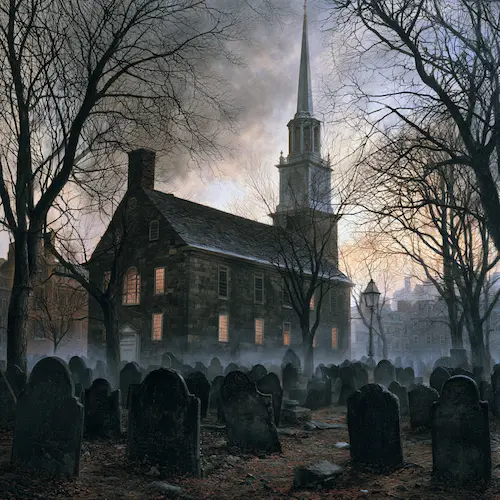
Image by Midjourney.com
Read more @ https://usghostadventures.com/uncategorized/the-haunting-history-of-the-boston-massacre-of-1770/
©2026 US Ghost Adventures. All rights reserved.