
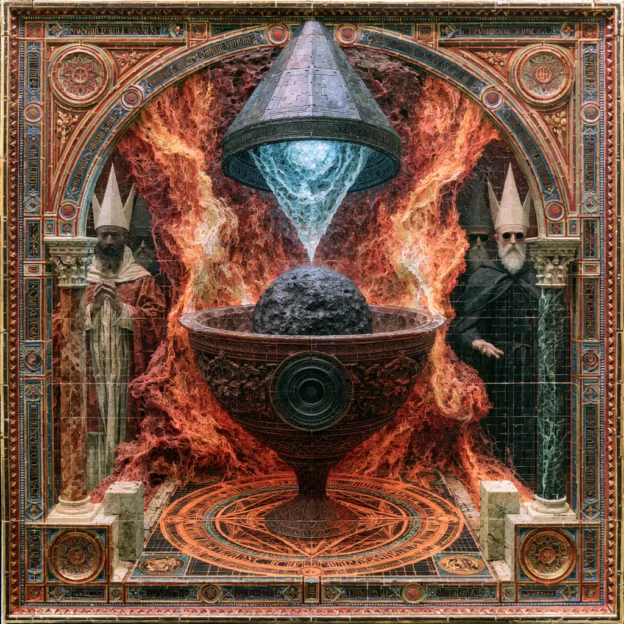
Image by Midjourney.com
Low Demiurgic Technology – The Philosopher’s Stone
The Philosopher’s Stone is not just a spiritual metaphor but an actual substance that can transmute lead or mercury into gold. The Stone is a product of Alchemy. Unlike chemistry, which only deals with physical matter and energy, Alchemy makes use of etheric and astral energies to reconfigure matter at the quantum level. Alchemy is to chemistry what a cube is to the square; it is a superset of chemistry and is capable of so much more.
How Etheric Energy Overrides Physical Laws
Alchemical achievements require successfully gathering, concentrating, and multiplying etheric energy. When this energy reaches a critical threshold, it overpowers the normal laws of physics and allows seemingly miraculous processes to take place. I believe it does this by biasing probability. By amplifying the probability of minor quantum effects, which are normally limited to the subatomic scale, they manifest on the larger atomic scale. In this way, one element spontaneously transforms into another.
The world around us is made of subatomic particles that regularly undergo unpredictable jumps, teleportation, bilocation, superposition, and other strange quantum behaviors. Why don’t everyday solid objects do likewise? Because the random quantum jittering of their subatomic particles collectively average out to zero. Think of a large crowd of people; seen from the air, the crowd as a whole is stationary, even though individuals within the crowd move in seemingly random directions. It’s because their movements are random and uncoordinated that they average to zero net movement on the whole.
The world we see around us is merely a crowd of subatomic particles whose individual quantum jumps aren’t apparent because they average to collective stillness. Physical laws that govern our everyday world, known as the deterministic laws of classical physics, are merely the laws of the crowd. These laws are what’s left of quantum physics after the unpredictability is removed through statistical averaging. They are not absolute laws; they are just the most probable manner in which matter and energy behave.
Physical laws can be bent. While the probability is incredibly low that enough coordination and coherence develops among the quantum jitters to manifest on a collective scale, that is exactly what etheric energy does. It alters probability and thereby skews the laws of thermodynamics, gravity, electromagnetism, and chemistry.
Alchemy does not violate the laws of physics, nor does it always follow them, rather it bends them as needed. It operates upon the quantum foundation from which these laws arise in the first place, via etheric energy affecting the probability of quantum events.
The Alchemy of Transmutation
Alchemy uses the code names salt, mercury, and sulphur to denote the different components of a substance.
- Salt denotes the physical component, the seat, base, matrix, anchor, or ark of the nonphysical aspects.
- Mercury is the etheric component and represents the dynamic, vital, transmutative, vivifying energy present within the substance.
- Sulphur denotes the archetypal identity or pure vibrational essence, analogous to the human astral body and spirit because it contains the “Idea” unique to that substance.
For example, in Alchemy an element like gold is seen to have three components: the salt of gold, mercury of gold, and sulphur of gold. These respectively denote the physical, etheric, and archetypal aspects of gold. Same goes for other materials employed in Alchemy, they also have their salt, mercury, and sulphur components.
The goal of transmutation is to impress the archetypal signature of one element upon another in order to change it to that element. By changing an element’s archetypal signature it cannot remain the same element.
What Alchemy does in the case of transmutation of lead into gold, is to
- extract mercury from etherically potent sources
- imbue it with the sulphur of gold
- store the combination in a suitable salt.
The result is then ready to impress its archetypal essence of “goldness” upon a different element responsive to transmutation.
This is the Philosopher’s Stone, or rather one form of it called the Red Stone because it is made with gold and assumes a red color.
Making the Philosopher’s Stone
Complete and accurate instructions for making the Stone don’t exist in one place. Nevertheless, a basic understanding can be pieced together from the sources listed at the end of this article. The following is my own tentative interpolation of these sources. My goal is not to give a detailed recipe, but to explain key features of the process because they are relevant to my thesis concerning the Demiurge.
Natural etheric energy is cosmic or biological in origin. Both derive it from a higher dimension. The center of stars including our Sun are dimensional windows through which physical and nonphysical energy enters our local universe. The Moon modulates and reflects what it receives from the Sun, therefore both Sun and Moon are our nearest cosmic sources of etheric energy. It accompanies sunlight and moonlight and enters into the atmosphere’s water vapor before condensing as morning dew.
Biological etheric energy comes from living things. That is because life incarnate cannot exist without etheric energy bonding consciousness to the body. Thus bacteria, plants, animals, and humans all contain and emit etheric energy. However, the quality of this energy varies depending on the source. Just as the Moon colors what it receives from the Sun, so do lifeforms color what they receive from a higher dimension.
Thus not all forms of etheric energy are appropriate for the creation of the Stone since plant, animal, and human emissions are too distant from the Stone’s own nature, which is more that of a living mineral. Hence the Alchemists limited their search to the cosmic and mineral realms. And if they did look to the biological realm for assistance, they would only have found it among the most primitive of bacteria, for these are closest to the mineral kingdom.
Water is an attractor and carrier of etheric energy, but it is not the only one. Salts also serve that function. Many different kinds of salt exist, all of them consisting of a metal joined to a non-metal. Table salt is sodium joined to chlorine, sphalerite is zinc joined to sulfur, while galena is lead joined to sulfur. Other metals such as iron, copper, magnesium, calcium, cadmium, etc. can form salts1.
Metal is another good attractor and carrier of etheric energy. Of all common metals, Alchemists say that iron has the greatest affinity for etheric energy. It is therefore a curious fact that blood, the carrier of such energy in our bodies, consists mostly of water, iron, and salt. It is also interesting that in folklore and occultism, a piece of iron, a line of salt, or a stream of water can act as barriers to unfriendly nonphysical entities, who would have their energy siphoned away by these substances. Garlic and onions play a similar role in folkore, and their key component is the element sulfur. Sulfur is yet another etherically active substance.
To know what materials Alchemists selected to make the Stone, you must understand how they thought. In the old days, Alchemists believed that metals originated in the Earth when dew from the heavens condensed on the ground, worked its way downward, and met with heat and vapors percolating upwards from the center of the planet. The combination produced a primitive metallic seed out of which all other metals grew. They believed that various metals were this one seed at different stages of growth, with gold being the final stage.
Gold was considered to be oldest of the metals, the final state toward which other metals were evolving. But in its old age, gold had expended all of its etheric energy. What was left was a dead body (salt) carrying the image (sulphur) of gold, but lacking the youthful vitality (mercury) that younger metals still possessed. Thus the goal of Alchemy was to take the noblest of metals and reinvigorate it, thereby taking it to a state of evolution higher than anything achievable in nature.
In practice, this meant starting with the youngest of metallic products, one so early in its evolution that it wasn’t yet a robust metal but rather more of a primitive metalloid. It had to have an affinity for gold and be a potent source of etheric energy, something that contained the secret fire of the cosmos. Alchemists chose a mineral that resembled gold but appeared darkened by impurities. This raw matter they crushed to a fine powder, fed with dew and oxygen, and incubated with heat.
Their aim was to induce putrefaction in order to unbind the matter’s mercury, salt, and sulphur components, just as death unbinds the human physical, etheric, and astral bodies. This was difficult because putrefaction takes a long time in the mineral kingdom and the speed depends on the electrochemical qualities of the mineral which varies from mine to mine as well as the presence or absence of bacterial catalysts.
In any case, when the appropriate factors are present, the mineral decomposes as intended. In successfully extracting the mercury and salt from this mineral and leaving behind the impure sulphur, they now had a youthful body and soul that could be joined to gold’s ancient spirit. This mercurial salt they called their secret fire, universal solvent, the “water that does not wet the hands”, common mercury, and alkahest. Alchemists believed it was the one thing by which the whole work could be accomplished, the one agent that could dissolve gold and acquire its sulphur.
In the so-called “Dry Path” of making the Stone, this salt and the gold leaf are placed in a crucible and heated to glowing temperature for several days, thereby joining them into one. This path is the quickest but also the most dangerous due to the high temperatures and potential for explosions. In the “Wet Path,” gold leaf is mixed into the water-solubilized salt, then sealed in a glass flask and heated until the gold is fully disaggregated by the universal solvent. The result is a white buttery substance some have called “philosophical mercury,” and this is the Philosopher’s Stone in its nascent form.
After putrefying this white substance to blackness, heating until its impurities are driven away and it turns white once more, then further heating and repetition of this process eventually produces a red oil on the surface. This red oil is the sulphur of gold completely fused with youthful mercury. Further heating and evaporation coagulates the oil into a solid. This solid is the Philosopher’s Stone in its finished form, unless one wishes to multiply its power by dissolving it in more fresh universal solvent (which is a donor of etheric energy) and repeating the previous operation, except using the Stone instead of gold leaf this time. This can be repeated any number of times, and each time a fresh dose of etheric energy impregnates the solid or oily remains and takes the Stone to its next order of power.
Upon attaining success, the final result is a dense stone, red and translucent like a ruby. It is water-soluble, melts like wax, flows like quicksilver when melted, does not burn at any temperature, yet volatizes when thrown into the molten metal it aims to transmute. It is a physical substance supersaturated with etheric energy and imprinted with the vibrational fingerprint of gold. When pulverized, mixed into beeswax, and cast into molten lead, it transmutes a certain multiple of its weight of lead into gold. It can also transmute quicksilver the same way. The lead or quicksilver atoms are overwhelmed by the etheric potency of the Stone and become malleable at the quantum level, allowing the fingerprint of gold to reconfigure them accordingly, thereby converting these into gold.
Alchemists emphasize that to succeed in this work, one must be of the highest ethics, have a deep mind capable of penetrating the mysteries of nature, and be a good observer and experimenter. Prayer and purity are essential to receive the intuitive insights and synchronistic guidance needed to discover the right steps in the right order. This is important because the less one understands about Alchemy, the more hidden variables there are, the lower the chances of success by trial and error. But if you are decreed so by destiny, or if you attain sufficient spiritual purity that higher forces deem you responsible enough to handle it, then you will be synchronistically and intuitively guided to success. But that won’t happen if you are driven by greed, skepticism, or other anti-spiritual motives, or if it goes against your karma and destiny. You don’t find the Stone, the Stone finds you.
The secret is synchronistically encrypted from those who would use it to cause trouble for themselves or others. Even misguided help can be a form of damage, thus in addition to purity, wisdom is needed. And if by chance someone did discover it and attempted to cause trouble, they would likely die suddenly, as already happens to people who try to bring antigravity and free energy technology into the world. The Philosopher’s Stone is of that same vein. That’s why no Alchemist has ever revealed the full picture. They not only realize the terrible implications of its misuse, but fear what harm might come to themselves if they facilitate that by giving knowledge without sufficient discretion.
Again, here I only give a general and limited estimation of the process for the sake of illustrating the underlying dynamics involved, as they are pertinent to my exposition on the Demiurge.
Other Applications of the Stone
At the first order of multiplication, a minuscule portion of the Stone may be dissolved in water or wine, and thereof a small portion ingested daily. This “Elixir of Life” or “Universal Medicine” is claimed to strongly energizes one’s etheric body. With a reinforced etheric body, the physical body is less impacted by the degrading effects of linear time and may even reverse aging. Additionally, psychic powers begin to manifest as a function of increased etheric energy current output. So you can imagine what became of Alchemical masters who succeeded in producing the Stone and made full use of it. They became more than human. However, they presumably had the spiritual maturity to handle this. Any ordinary person, in being more psychically fragile, would go crazy, get sick and die from being unable to handle the increased etheric current load.
This “Universal Medicine” takes on great importance in Alchemy, because it represents a true panacea, something that cures all ills by charging the diseased organs with vital energy so that rightful health is regained. This goal is far more important than the transmutation of metals. In fact, the transmutation is done primarily as a test to see how strong the Stone, and thus whether it is safe for ingestion because beyond the first power it is no longer safe to use as a medicine.
In another application, by the seventh or eighth order of multiplication, the Stone remains liquid begins to physically glow, even more brightly if multiplied again. It glows continually without exhaustion. This is what powers the fabled “eternal lamps” in occult lore. And if multiplied beyond a certain point, it is said to eat through glass and even explode in something akin to a matter-antimatter reaction, which is obviously very dangerous. This shows that etheric energy, concentrated beyond a certain point, may initiate an outpouring of electromagnetic energy. This make sense because ether is the precursor and precipitator of matter, energy, space, and time.
Thus the Stone, in its full application, potentially provides wealth, health, psychic power, and light. No wonder it has been kept so secret through the ages, mainly to keep it out of the hands of unscrupulous individuals whose misuse of these powers would bring catastrophic consequences upon the world. That is not to say such catastrophes haven’t happened.
Alchemy as Demiurgic Technology
What we have here is Demiurgic technology. How so? Recall that the Demiurge has an astral and etheric body. The etheric shapes matter according to the archetypes or “vibrational patterns” contained in the astral.
Well, the Philosopher’s Stone is a physical object charged with etheric energy, carrying the vibrational pattern of gold. It can reshape physical matter like lead or mercury into conformance with that vibration. Thus the Stone is a physical object imbued with Demiurgic power. The technology of using etheric and astral energies to reconfigure matter is hereby called Demiurgic technology.
The most remarkable thing is that it’s made by human hands, which is the closest thing to hyper-dimensional technology that one person in an attic laboratory can produce using everyday materials and uncommon techniques.
But even with all its purported greatness, the Philosopher’s Stone is only an elementary demonstration of a science with far greater potential. Alchemy as we know it is a primitive form of hyper-dimensional science. Producing the Stone is like wrapping a wire around a nail, connecting it to a battery, and rejoicing in it becoming an electromagnet. But higher forms of Demiurgic technology exist that can produce something more like a billion-dollar supercollider. Both the wire-wrapped nail and supercollider employ the same basic principles of electromagnetism, but the first is a trivially simplistic version of the latter.
In the Philosopher’s Stone we have proof, through circumstantial evidence and logicality of its existence, of what can be scaled up to an even higher level. Remember, the power of the Stone lies in its etheric potency, and its potency determines the degree to which it can bias probability and influence physicality. The archetypal fingerprint determines the nature of this biasing.
The weakest etheric fields can only nudge an electron this way or that. A bit stronger can nudge neurons and living cells. Even stronger it can influence synchronicity. Stronger, it can override chemical laws and allow for elemental transmutation or psychic spoon bending. You can scale this up higher and higher until you reach a point where the entire world, our entire timeline, can be shifted, reconfigured, reprogrammed, transmuted. Etheric energy does all this at the quantum level, which is the foundation of our physical reality.
That Alchemy can only produce these effects on the chemical scale, places it in the category of Low Demiurgic Technology. So what, then, is High Demiurgic Technology? It is that which does to the universe what Alchemy does to gold leaf and lead ingots. It can manufacture an artifact charged with such unbelievable amounts of etheric energy as to dissolve and reconfigure the world in accordance with the artifact’s programmed archetypes.
This object is a kind of “World Philosopher’s Stone”, the macrocosmic equivalent to the Philosopher’s Stone.
High Demiurgic Technology – The Holy Grail
The Grail is an object with supernatural powers brought to our world by otherworldly forces. The Ark of the Covenant was a container constructed by ancient Hebrews, during their flight from Egypt, to house a powerful artifact.
Since descriptions of the Ark’s capabilities closely parallel those of the Grail, what the Ark contained may have been the Grail. As to their ultimate purpose, both the Grail and Ark were generally portrayed as physical embodiments of a god-like intelligence.
The Grail subject has several complementary aspects: 1) The technology. What it is, and what it does. Its physical nature, function, and purpose. 2) The history. The events that lead to its creation and introduction to our world. Who is responsible for it. What it has done, and will do, to our world. 3) The spiritual metaphor. What it represents within all of us. What is indicated about a proper course of spiritual development.
I will explore these in sequence over the coming articles, reserving the spiritual aspect for last because it concerns the solution to a problem I have yet to delineate. If it seems like I’m getting hung up on the technology, it’s only because I find it a prerequisite for understanding the reasons behind the historical aspect, which then underscores the gravity of the spiritual aspect.
I will begin by addressing the functional characteristics of the Grail and in my next article follow up with those of the Ark. From this, it will become clear how competition over, and the abuse of such immense power can, has, and will have catastrophic consequences for our world.
Medieval Literature Describes the Grail
The original Grail legends preceded Christianity. Later the Church retrofitted these pagan tales with Biblical symbolism and context. From that retrofitting we get the popular notion that the Holy Grail was the cup from which Jesus Christ served wine at the Last Supper, which later caught his blood as he died on the cross, or the notion that it was a platter carrying the decapitated head of John the Baptist.
Of all medieval authors who wrote of the Grail, Wolfram von Eschenbach seemed most privy and sympathetic to the pagan/gnostic stream of Grail lore. He was a wandering knight, scholar, poet, and singer — the German equivalent of troubadour — who associated with secret societies like the Templars or was a member himself. In his book Parzival, he tells the tale of a foolish boy named Parzival who leaves home to become a knight. This boy is destined to become Grail King but out of timidity fails miserably when eventually offered the opportunity. Cursed for his failure, he spends several years in utter dejection undergoing numerous hard trials before developing the inner strength to fight for his destiny regardless of the failure. And only by this inner resolve and being true to his Self does he earn his second chance and finally become Grail King.
Embedded within this plot are periodic references to the Grail, its origins and functions. These are set within a Christian context that, upon closer inspection, disguise a more Gnostic, pagan, pre-Christian core. In other words, Wolfram may have had the inside scoop on the Grail and inserted what heretical truths he could between the obligatory religious veneer, as is evident from the odd details pertaining to the Grail that fit poorly within Biblical context.
That is not to say the other Grail books are worthless, because their retrofitting occasionally kept the original meaning relatively intact. For instance, if Jesus Christ was the incarnation of a personified extension of the Logos, which is the spiritualized aspect of the demiurge, then you can see how a cup holding his blood is identically a physical vessel holding demiurgic energy. You have already encountered one example: the Philosopher’s Stone, of which the Grail is a higher order relative. Or consider the platter holding the head of John the Baptist; John poured “living water” upon Jesus and baptized him, indicating his symbolic function as the conferrer of that which made Jesus more than mere man, that is to say he symbolized the Logos, and “Logos” being associated with mind/intellect may explain the head-on-a-platter visual. These are examples of ecclesiastical steganography.
In Wolfram’s Parzival, the Grail was neither cup nor platter, but an otherworldly stone. It was called neither “Holy Grail” nor “Holy Vessel” but simply the “Graal.” It was treated as a strange and marvelous non-terrestrial artifact. To avoid redundancy, I will call it “Grail” instead of “Graal.” Here is how Wolfram characterizes it:
It was paradisal and transcended all earthly perfection. This implies it was more than just a hunk of rock. Rather its perfection extended beyond the earthly material level.
It was cared for by a woman of perfect chastity and purity, and all who served the Grail must forego carnal love. This means spiritual integrity was of vital importance for those who interacted with it.
It would only let itself be carried or moved by a perfectly chaste woman. This implies it has some level of volition to choose whom to let itself be carried by.
It would instantly materialize whatever food and drink was desired by those who held their cups and plates before it. This means it could turn thoughts into reality, and functioned as a stone of plenty.
It could only materialize what the earth already yields in terms of food and drink. This means it cannot just materialize any thoughts, only foodstuffs that already exist. This carries shades of an uncreative demiurge.
It receives its power to materialize from a Dove that flies down from heaven every Good Friday and leaves a white wafer on the stone. This is a mix of pagan and Christian symbolism. Aside from the religious aspects, it also has to do with raw energy charging the stone at a specified time. Take note that Good Friday is the Friday following the first full moon after the vernal equinox. The date is entirely astrological/astronomical and may signify maximum cosmic etheric inflow.
It would impart vitality to any who looked upon it, restoring youth, delaying death, and curing illness. One could live for hundreds of years without growing old this way, save for hair turning gray. This means the Grail emits very strong life-force energy, aka etheric energy, just like the Philosopher’s Stone.
It would give written messages via mystical letters appearing on its surface. These letters would vanish after being read. Messages included the names of children in the world who would be called to serve in the Grail castle, and other dictates. This means the Grail possessed intelligence, or relayed communications from some intelligence with preference for letters and writing. It also means the Grail served as an oracle.
It was invisible to those who were not baptized. This means it takes an infusion of divine energy into one’s consciousness, an opening of perception, to be able to see the Grail. Otherwise it remains invisible before one’s eyes. This is a very gnostic concept, to have one’s third eye opened through divine grace or initiation. It implies the Grail is tangible but not necessarily always fully here in the world, rather shifted slightly from our reality and requires expanded perception to see.
By its virtue, the Phoenix burns to ashes and is born anew more splendid than before. This metaphor is clearly alchemical symbolism, though more generally it indicates the transformation of something, like a person or whole world, into a more perfect form through dissolution and reformulation.
There is question of how close Wolfram stuck to the original tale, and how close the original was to the truth. Eschenbach says he was told the story by one called Master Kyot, who came across it in an old book written in Arabic by a “heathen” astronomer named Flegetanis. Flegetanis himself was somehow privy to the truth concerning the Grail and its origins, having written, “A troop left it on earth and then rose high above the stars, if their innocence drew them back again. Afterwards a Christian progeny bred to a pure life had the duty of keeping it. Those humans who are summoned to the Grail are ever worthy.” Kyot went looking in the literature of Britain, France, and Ireland for mention of this “Christian progeny” and at last found a tale of their existence in Anjou, France, of which the Parzival story is a second-hand recounting by Eschenbach.
Not mentioned by Wolfram, but claimed by other books of the period:
The Grail could glow bright as the sun and impart enlightenment to those who looked upon it. Recall the Philosopher’s Stone glowing when multiplied beyond a certain point, and that its potent etheric energy output assists with psychic activation.
It was carried by cart or ship from castle to castle instead of being home to just one. This meshes with the Grail leaving a breadcrumb trail from location to location throughout history, from ancient Egypt to medieval France and other places.
It could unleash a fiery energy surge capable of knocking someone out. The Ark of the Covenant possessed the same trait.
Only those qualified to wield the Grail could sit in a special seat called the Siege Perilous, all others would be swallowed by a vortex that opens beneath them, should they attempt to sit in that chair. While figuratively underscoring the necessity of utmost spiritual strength and purity in those who seek the Grail, the vortex/whirlpool is a peculiar detail that may stem from a literal observation of the Grail’s destructive behavior in the presence of unworthy individuals.
It was more often in the custody of heavenly beings, who would present it to humans according to circumstance and subsequently withdraw it back into their realm. Sometimes it was in human possession, other times it was retrieved for safekeeping by its otherworldly guardians.
If these latter claims are valid and literal, they don’t necessarily contradict Wolfram’s account because his primary source concerned events from the time of King Arthur several centuries earlier. In the intervening period more may have happened regarding the Grail from which additional streams of information beside his own could work their way into the books of his time. So I would append these details to the ones provided in Parzival to paint a more complete picture of the Grail.
Taken at face value, in the Grail we have a stone or crystal-like object of variable physicality that emits powerful life-force energy, can translate thoughts into material foodstuffs, has seeming intelligence and volition, functions oracularly, and requires high spiritual integrity from those who wield and serve it lest they be destroyed by it.
Is the Grail Real?
How do we know the Grail is an actual artifact and not just a metaphor for spiritual ideals or a veiled allusion to the Philosopher’s Stone?
1) Because its footprints are found in actual history and not just literature. I will leave the tedious history of people like the Phoenicians, Egyptians, Celts, Cathars, and Templars for books listed at the end of this article, but will say for now that for each of these a magical stone or crystal artifact with supernatural qualities played part in their origins, organization, and power. They were at some point in possession of something important, closely guarded, and endowed with the traits of demiurgic technology. It conferred to them special guidance and abilities without which their achievements would not have been possible.
2) Because its characteristics go beyond that of the Philosopher’s Stone in a manner suggesting these extra features are not just arbitrary embellishment based on fantasy, but extensions made with logical adherence to the principle of demiurgic science. In other words, if Grail myths simply encoded alchemical knowledge, the described Grail functions would be limited to those of the Philosopher’s Stone and anything beyond that would be made up and thus physically implausible. Yet these extensions, like materializing food out of thin air or functioning in an oracular manner, are perfectly plausible and in line with demiurgic science, as will be explained later. The Grail can do what the Stone cannot, but only because those who make the Stone lack the ability to take demiurgic science to the higher level of which the Grail is a product. If the Stone exists, then so ought the Grail by extension of that same science.
3) Because while anyone with the right knowledge and integrity can make the Philosopher’s Stone, the Grail was something sought and fought over as if there were only one. It wasn’t something that could be made as needed. Therefore it was a unique artifact and not just a recipe. It was a real object carried around via carts, barques, and arks.
4) Because the medieval Grail was the surviving remnant of the ancient Ark of the Covenant, or at least another fruit from the same tree of demiurgic science. The Ark was undoubtedly a real artifact with real powers and not just myth and metaphor, therefore if the Ark of the Covenant with its alleged functions once existed, then the Grail with its purported powers can exist also, for both are of the same caliber.
Although it bears similarity to the Philosopher’s Stone, it is not identically the Stone. Although its human seekers must undergo an arduous path of spiritual strengthening and purification to approach and serve it, the Grail is not just a metaphor for spiritual evolution. Although it employs etheric and astral energies in its operation, it is not just a visual metaphor for these energies but a vessel containing and radiating them. It is hyper-dimensional, spiritual, demiurgic technology representing a union of all such interpretations.
What are the origins of the Grail?
As will be shown in a later article, what medieval literature says concerning the origins and characteristics of the Grail deeply correlates with Celtic, Greek, Scandinavian, Persian, Egyptian, Mayan, and Indian mythology. The common origin of these myths explains who brought the Grail to our world many millennia ago: an advanced civilization possessing demiurgic technology. Further clues on their identity is provided by modern alienology, Fortean research, Rosicrucian studies, contactee culture, and quality channeling literature. This suggests not only that the Grail is as important today as it was in ancient times, but that its supernatural progenitors are still with us.
The Grail is a mysterious artifact with supernatural powers. What is such an otherworldly artifact doing in our world? Who made it, where did it come from, and how did it come into human possession? The angles of approach to these questions are diverse: medieval Grail legends, Indo-European mythology, occult literature, and the modern fields of Fortean phenomena and alienology; but they all converge upon the same answer.
In Parzival, the Christian hermit Trevrizent explains how it was brought to earth by a group of “noble and worthy” angels after they were exiled from Heaven for refusing to take sides when Lucifer waged his rebellion. God commanded these neutral angels to bring the Grail to earth and entrust it to a divinely appointed line of spiritually pure humans. That is to say, they were exiled and divested of the Grail. They are the so-called Fallen Angels.
As to what became of these exiled angels, Flegetanis said they “rose high above the stars” after dropping off the Grail. Trevrizent seems to concur, initially saying they returned to Heaven if their innocence called them to return and God willed it, which is a Gnostic concept concerning the redemption of evil, something the Church would find offensive since Fallen Angels were supposed to be eternal enemies of God without possibility of redemption. Later in the book, Trevrizent admits this was a lie and that these exiled angels were actually eternally damned and eternal enemies of God and his appointed Grail guardians, that they had no hope for redemption. This recanting is thought to have been Wolfram appeasing the Church.
It’s also possible that in the original streams from which the story of Parzival was derived, both are true: the neutral angels polarized into two groups, one rising closer to divinity, the other falling further. Some would therefore be higher guardians of the Grail cooperating with their human counterparts, while the others, having been fully divested of the Grail, would be their adversaries desiring to regain it for themselves. This would resolve the seeming contradictions in Grail legends concerning otherworldly beings both helping guard it from abuse and attempting to steal it from its rightful guardians. Thus the legends suggest that a duality exists among these higher beings. For instance, in Lucifer’s Court, (p. 21) Otto Rahn recounts a variation of the tale: the Grail was a gemstone knocked loose from Lucifer’s crown during the fall of the angels, which his forces have since been trying to repossess.
Stripping the religious gloss from the above accounts, the basic story is that some catastrophe in another realm forced a group of beings to leave with a powerful artifact. They came to Earth and entrusted it to a line of spiritually elite humans through whom the artifact continued its function.
Wolfram called it lapsit exillis, meaning “stone of exile” in his garbled Latin, because it was taken from its home and brought to earth by forces exiled by some cataclysmic event. This motif repeats itself throughout human history, whereby the artifact is endangered and must be moved to a new location. There it establishes its power for some time before peril strikes once more, forcing another relocation, and the cycle repeats.
One example is the Israelites fleeing Egypt under catastrophic conditions and taking the early Ark of the Covenant with them, through which they win victory, guidance, prosperity, and power. When the Temple of Solomon was sacked, the Ark was spirited away and disappeared from Jewish history. I will discuss the Ark in more depth in my next article because it gives further insight into the nature of demiurgic technology and introduces the historical turn of events that precipitated a negative deviation of the timeline.
Tom Montalk – http://montalk.net/gnosis/174/the-philosopher-s-stone http://montalk.net/gnosis/182/the-holy-grail