
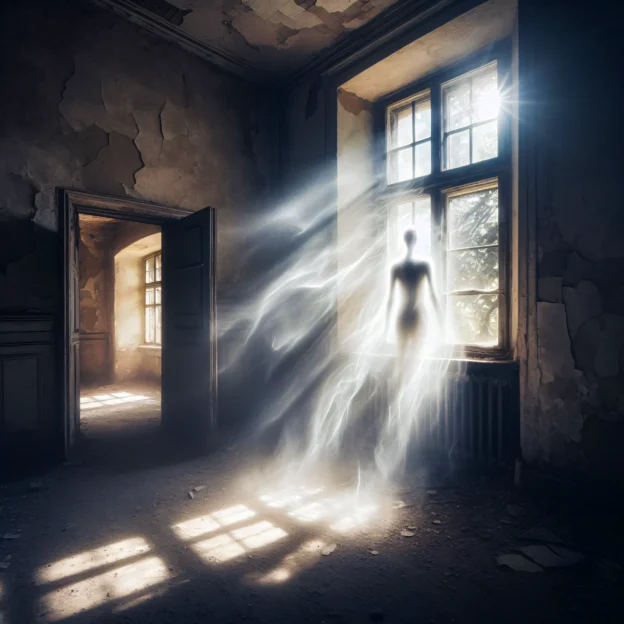
Since early childhood, Carl Jung experienced paranormal phenomena, that is, phenomena that are beyond the scope of scientific understanding. As a child, he continually heard stories of uncanny happenings such as “dreams which foresaw the death of a certain person, clocks which stopped at the moment of death, glasses which shattered at the critical moment.” The reality of these events, he says, was “taken for granted in the world of my childhood.”
Jung’s personal experiences with the paranormal would set him on a quest to find an explanation of these events with his theory of analytical psychology, as well as sparking his interest in parapsychology, the study of psychic or paranormal phenomena, especially regarding extrasensory perception or ESP (precognition, clairvoyance, telepathy, intuition, etc).
Paranormal experiences were virtually commonplace in Jung’s family. His maternal grandfather, Rev. Samuel Preiswerk, who had learned Hebrew because he believed it was spoken in heaven, found himself continually surrounded by ghosts and would devote one day every week to conversing with the spirit of his deceased first wife, keeping a chair for her in his study – much to the dismay of his second wife Augusta Preiswerk (Jung’s maternal grandmother). Augusta was clairvoyant and a spirit-seer. This gift is traced back to an event that she had at the age of 20, where she fell into a coma for 36 hours. She would sometimes see apparitions of persons unknown to her, but whose historical existence was later proved. Augusta is credited with bringing “the Occult strain” into the family.
Jung’s mother, Emilie Preiswerk, also experienced “strange occurrences” with sufficient regularity to write a diary exclusively dedicated to them. Her father, Samuel, insisted that she sit behind him when he was writing his sermons, as spirits were disturbing him. Emilie spent much of the time in her own separate bedroom, enthralled by the spirits that she said visited her at night.
Jung described his mother as having two personalities. At day she was a loving mother, but at night she seemed mysterious and terrified Jung. Unlike Jung’s father, who was more predictable. Both his mother and father were the 13th children of their families.
Jung writes of a childhood experience:
“From the door to my mother’s room came frightening influences. At night Mother was strange and mysterious. One night I saw coming from her door a faintly luminous, indefinite figure whose head detached itself from the neck and floated along in front of it, in the air, like a little moon. Immediately another head was produced and again detached itself. This process was repeated six or seven times.”
Carl Jung: Memories, Dreams, Reflections
As a young assistant physician at Burghölzli in Zürich, Jung was working on his word association experiments. One day, his mother came to visit him, and looked at the whole room which was plastered with graphs. She looked confused and asked him what it was about. Jung replied that they were they for his experiments. Then she said with her “second” voice, “Well, do you think it could be something?” Jung stated:
“My mother rarely spoke in this tone – but when she did, she would intuitively and unexpectedly say something of great significance… Her question affected me so much that I could not lift a pen for the next three weeks. Her words had unflinchingly exposed my own doubts about the importance of my undertaking, and now I asked myself in all seriousness whether what I was doing really made sense.”
Reflections on the Life and Dreams of C.G. Jung by Aniela Jaffé
Just like his mother and grandmother, Jung had also described himself as having a dual personality, which he called personality No. 1 (aimed at social integration), and personality No.2, which was ancient, deeply knowledgeable, and “close to nature, to the night, to dreams, and to whatever God worked directly in him.”
When Jung was studying at home one morning in 1898, he was surprised by a sudden loud crack. He found that a heavy walnut table that had been in his family for generations had split right across. Two weeks later, he heard another sound. This time he saw that inside the cupboard, the bread knife which had been used just an hour ago had been broken into four pieces for no apparent reason. Jung decided to keep these as a reminder of the powerful forces of the unseen realm. They are still in the possession of the Jung family.
Séances and Occult Phenomena
Jung’s own account presents these incidents as connected with séances (an attempt to communicate with spirits) which he claims he started attending a few weeks later, but which in fact he had already been attending for several years. The table had been used in these sessions, in his own home, the medium was his cousin Helene Preiswerk, and his participants, members of his own family. In addition, a number of spirits with which the medium was in communication with, were none other than Jung’s ancestors.
When he was an undergraduate, Jung discussed the occult and the esoteric in a student club (known as the Zofingia lectures), including the existence of the soul, the reality of spirits, psychokinesis, messages from the dead, hypnotism, clairvoyance and precognitive dreams. A scientific explanation of these is doomed to failure so long as it is based on the principle of causality. After all, how can an event in the future be the cause of a dream that is taking place in the present, so that it reflects itself and is anticipated in it? How can a man dying in New York cause a person somewhere in Europe to have a premonition of his death, let alone cause a clock to stop or a glass to shatter?
For the thinking of Western man, it is insuperably difficult to give up the principle of causality – and to accept the reality of acausal connections, as has been done in the East for millennia, with, for example, the ancient Chinese oracle of the I Ching – which Jung was greatly fascinated by. Jung used the I Ching in critical situations of his life and his patients, finding a great deal of meaningful answers and unusual psychological insights from it. He could write all 64 hexagrams from memory and considered them as readable archetypes.
Jung continued to attend séances and conducted a series of experiments with mediums in which he witnessed materialisation, the creation or appearance of matter from unknown sources, as well as dematerialisation. Jung stated, “I have seen enough of this phenomenon to convince me entirely of its existence.” He also witnessed levitation on several occasions. He writes:
“The most striking cases of levitation which I have witnessed have been with Mr. Home. On three separate occasions have I seen him raised completely from the floor of the room. Once sitting in an easy chair, once kneeling on his chair, and once standing up. On each occasion I had full opportunity of watching the occurrence as it was taking place. There are at least a hundred recorded instances of Mr. Home’s rising from the ground, in the presence of as many separate persons… To reject the recorded evidence on this subject is to reject all human testimony whatever.”
Carl Jung, C.W. Vol. 18: The Symbolic Life
At one séance, four of the five people present saw an object like a small moon floating above the abdomen of the medium. It was absolutely incomprehensible to them that Jung, the fifth person, could see nothing of the sort, although they repeatedly pointed out to him exactly where it was. From this, Jung inferred the possibility of collective visions on such and other occasions – for instance, the sightings of flying saucers.
Jung’s observations at these séances formed the basis of his doctoral dissertation published in 1902, entitled On the Psychology and Pathology of So-Called Occult Phenomena, which is included in in Volume 1 of the Collected Works, Psychiatric Studies. The desire to present his findings in an objective light is undoubtedly why this as well as his various subsequent accounts all conceal to various degrees the full extent of his personal involvement. Jung always considered himself first and foremost as an empiricist. He was also fully aware that the spiritualistic scene was populated with charlatans.
Jung admits that his period of the séances with his medium cousin contained the origin of all his ideas. He had discovered some objective facts about the human psyche. Jung was intrigued by how she manifested a completely different personality than her own while in the trance. This ability to manifest a variety of seemingly autonomous personalities would contribute to Jung’s formulation of complexes and archetypes. From then on, Jung got his first glimpse of the fact that there was another world (the unconscious) which had a life of its own quite apart from the life of consciousness.
In a letter, Jung writes about the troubles of understanding ghostly communication:
“Unfortunately, there are no cases on record where spirits had the good grace to present themselves as test-persons. Whatever else we can produce as spirit voices are those of mediums, and there the great trouble is to establish whether the communicated contents derive from the ghosts or from unconscious fantasies of the medium or of any other member of the circle. I would not go so far as to deny the possibility that a medium can transmit a ghostly communication, but I don’t know in which way one can prove it, as such a proof is outside of our human possibility… This whole question of so-called “occult phenomena” is nothing one could be naïve about. It is an awful challenge for the human mind.”
C.G. Jung, Letters Vol. 2 (1951-1961)
When Jung became a follower of Freud, he continued to study the paranormal. Freud rejected the subject and was dismissive, for he wanted to make the sexual theory “a dogma, an unshakable bulwark against the black tide of mud of occultism.” Later, however, Freud wrote in a letter to Jung “In matters of occultism, I have grown humble… my hubris has been shattered.” Still, he did not want to expose the full extent of his interest publicly.
On one occasion in 1909, Jung was having an argument about paranormal phenomena with Freud. Earlier in the evening Freud had formally adopted Jung as an eldest son, anointing him as his successor and crown prince. During the talk, Jung had a strange sensation, as if his diaphragm were made of iron and were becoming red-hot, and then suddenly there came a loud noise from the bookcase. Jung said that here was an example of a “catalytic exteriorisation phenomenon,” or psychokinesis. Freud dismissed this as “sheer bosh,” to which Jung replied that there would soon be a sequel, whereupon there was another loud noise from the same direction. Freud only stared aghast at Jung.
In 1961, the year of his death, Jung wrote in a letter:
“I have seen objects moving that were not directly touched, and moreover under absolutely satisfactory scientific conditions. One could describe these movements as levitation, if one assumes that the objects moved by themselves. But this does not seem to be the case, since all the objects that apparently moved by themselves moved as though lifted, shaken, or thrown by a hand. In this series of experiments, I, together with other observers, saw a hand and felt its pressure – apparently the hand that caused all the other phenomena of this kind. The phenomena have nothing to do with the “will,” since they occurred only when the medium was in a trance and precisely not in control of his will. They seem to fall into the category of poltergeist manifestations.”
C.G. Jung, Letters Vol. 2 (1951-1961)
Confrontation with The Unconscious and Synchronicity
Jung’s disagreements with Freud on the paranormal would contribute to their split. During this time, Jung entered the period of his “confrontation with the unconscious”, where he would have visionary or altered states of consciousness and communicate with his inner figures—forming the basis of his personal journals, the Black Books, and subsequently, the Red Book.
One of these figures was Philemon, a pagan with an Egypto-Hellenistic atmosphere and a Gnostic appearance, who represented “superior insight”, and communicated that there are things in the psyche which one does not produce, but which produce themselves and have their own life. One of the earliest experiences Jung mentions of a synchronicity or meaningful coincidence concerns this figure: Philemon had appeared in his dreams with kingfisher’s wings, and Jung, in order to understand the image better, did a painting of it. While engaged on this, he happened to find in his garden, for the first and only time, a dead kingfisher.
It was Einstein, who was Jung’s guest on several occasions at dinner, who started him off thinking about a possible relativity of time as well as space, and them being conditioned by the psyche. For Jung, parapsychology shows that the psyche has an aspect of a relative-temporal and relative-spatial character. This led, decades later, to Jung’s relation with the Nobel prize-winning physicist Wolfgang Pauli and to Jung’s theory of synchronicity.
In investigating quantum mechanics, physics has also been confronted with the problem of acausality and the relativity of spacetime. This is analogous to synchronicity. Jung writes:
“[Synchronicity] ascribes to the moving body a certain psychoid property [psychic and physical in nature] which, like space, time and causality, forms a criterion of its behaviour. We must completely give up the idea of the psyche’s being somehow connected with the brain, and remember instead the “meaningful” or “intelligent” behaviour of the lower organisms, which are without a brain. Here we find ourselves much closer to the formal factor which, as I have said, has nothing to do with brain activity.”
Carl Jung, Synchronicity: An Acausal Connecting Principle
As the statement reveals, Jung would have thought little of the focus on neurology and the brain for explaining psycho-physical realities.
ESP appears as a manifestation of the collective unconscious, which is the same everywhere and at all times. It manifests itself therefore not only in human beings, but also at the same time in animals and even in physical events through synchronicity. Psyche exists in matter and matter exists in psyche. In essence, the unconscious pervades the environment all around us and is not an encapsulated realm located exclusively within an individual, as we tend to assume. There is a microcosm-macrocosm relationship. To paraphrase the Emerald Tablet, “As above, so below”. This idea is known by many names: the unus mundus, the One, the pleroma, anima mundi, sympatheia or cosmic sympathy, animism, and so on.
There are people, however, that seem to possess a supernatural faculty and are able to make use of it at will. But, for Jung, this consists in their already being in, or voluntarily putting themselves into, a state corresponding to an archetypal constellation. Similarly, the religious attitude consists in surrendering oneself to God, which psychologically corresponds to a subordination of the ego to the Self or God-image.
Visions and Altered States
Prior to the outbreak of the First World War, Jung had apocalyptic visions of terrible destruction visiting Europe and rivers of blood; although he did not know what to make of them at the time, he realised it had been a premonition when the war broke out. Similarly, towards the end of his life, he had a disturbing vision of the last fifty years of mankind, which was never published and only exists in the notes of his daughter. His colleague Marie Louise von Franz tells us that he had another deathbed vision in which he stated, “I see enormous stretches devastated, enormous stretches of the earth. But, thank God not the whole planet.”
During the Second World War, when Jung was returning from Bollingen by train, he was overpowered by the image of someone drowning. When he walked home, his daughter’s children told him that the youngest of the boys had almost drowned, but his older brother had fished him out. This had taken place at exactly the time Jung had been assailed by that memory in the train.Jung had another similar experience before a death in his wife’s family. He dreamt that his wife’s bed was a deep pit with stone walls. It was a grave. Then he heard a deep sigh, as if she took her last breath. A figure sat up in the pit and floated upward, wearing a white gown with black symbols. Jung woke up at three o’clock in the morning and checked on his wife. At seven o’clock came the news that a cousin of his wife had died at three o’clock in the morning.
When he visited Ravenna in Italy, Jung experienced a peculiar vision or mystical experience. The first time, in 1913, he found the tomb of Roman empress Galla Placidia significant and fascinating. The second time, twenty years later, Jung had the same feeling. Once more he fell into a strange mood in the tomb and was deeply stirred. He was there with an acquaintance, and they went directly from the tomb into the Baptistery of the Orthodox. Jung writes:
“Here, what struck me first was the mild blue light that filled the room; yet I did not wonder about this at all. I did not try to account for its source, and so the wonder of this light without any visible source did not trouble me. I was somewhat amazed because, in place of the windows I remembered having seen on my first visit, there were now four great mosaic frescoes of incredible beauty which, it seemed, I had entirely forgotten… The fourth mosaic… was the most impressive of all. We looked at this one last. It represented Christ holding out his hand to Peter, who was sinking beneath the waves. We stopped in front of this mosaic for at least twenty minutes and discussed the original ritual of baptism… Such initiations were often connected with the peril of death and so served to express the archetypal idea of death and rebirth… I retained the most distinct memory of the mosaic of Peter sinking, and to this day can see every detail before my eyes… I went to Alinari to buy photographs of the mosaics, but could not find any… When I was back home, I asked an acquaintance who was going to Ravenna to obtain the pictures for me. He could not locate them, for he discovered that the mosaics I had described did not exist… The lady [Toni Wolff] who had been there with me long refused to believe that what she had “seen with her own eyes” had not existed… I was able to ascertain that at least the main features of what we both saw had been the same. This experience in Ravenna is among the most curious events in my life.”
Carl Jung: Memories, Dreams, Reflections
In 1944, Jung achieved a glimpse behind the veil and had a near-death experience. He further reflected on the afterlife after the death of Toni Wolff and Emma Jung. Just before his death, Jung said that Toni had supplied the “fragrance” of his life, while his wife, Emma, had supplied “the foundation”.
Jung felt that Toni’s natural tendency was very down-to-earth, but she became very intellectual and neglected this part of her life. Jung contemplated on the theory of reincarnation. If one believes in the possibility of it, the idea logically follows that those people who are reincarnated did not complete something in their life that they were meant to do. Jung narrates a dream he had of Toni where she had returned to life, and was a farmer in the Umbrian countryside in Italy, working the land. She was tanned from the sun and had a tremendous vitality, which she never had in reality. He felt that Toni was closer to the earth, and she could manifest herself better to him in the sphere of three-dimensional experience.
With his wife Emma, on the other hand, he had a different impression. He had dreams after her death in which she was working on her studies of the Holy Grail.
She seemed to be further along the spiritual path, and Jung felt a great detachment or distance from her, as if she was on another level where he couldn’t reach her.
The Seven Sermons of the Dead
In 1916, Jung felt compelled from within to formulate and express what might have been said by Philemon. This gave birth to the Septem Sermones ad Mortuos (Seven Sermons of the Dead), a collection of seven mystical or “Gnostic” texts which Jung published under the pseudonym Basilides, an early Christian Gnostic teacher. It all began with a restlessness, and an ominous atmosphere surrounded him. Then his house began to be haunted, and Jung’s 12-year-old daughter Agathe, who had inherited her grandmother’s psychic abilities, would see ghosts.
Jung writes:
“Around five o’clock in the afternoon on Sunday the front door-bell began ringing frantically. It was a bright summer day… Everyone immediately looked to see who was there, but there was no one in sight. I was sitting near the doorbell, and not only heard it but saw it moving. We all simply stared at one another. The atmosphere was thick, believe me! Then I knew that something had to happen. The whole house was filled as if there were a crowd present, crammed full of spirits. They were packed deep right up to the door, and the air was so thick it was scarcely possible to breathe. As for myself, I was all a-quiver with the question: “For God’s sake, what in the world is this? Then they cried out in chorus, “We have come back from Jerusalem where we found not what we sought.” That is the beginning of the Septem Sermones. Then it began to flow out of me, and in the course of three evenings the thing was written. As soon as I took up the pen, the whole ghostly assemblage evaporated. The room quieted and the atmosphere cleared. The haunting was over.”
Carl Jung: Memories, Dreams, Reflections
Jung stated that the discussion with the dead in the Seven Sermons formed the prelude to what he would subsequently communicate to the world, expressing in germinal form Jung’s most important ideas: the nature of the unconscious, individuation, archetypes, the problem of opposites, and the Self.After his encounter with the ghosts, Jung sketched in his journal the outlines of his first mandala, the Systema Munditotius, which forms a pictorial cosmology of the vision conveyed in the Sermons. It was published anonymously and shown at the Eranos conferences. The mandala portrays the antimonies of the microcosm within the macrocosm. The figure of Abraxas, the Great Archon in Gnosticism, is depicted here, who represents the dark antithesis in the depths, the builder of the physical universe, a world-creator of an ambivalent nature. Sprouting from him we see the tree of life. The lower world of Abraxas is characterised by five, the number of natural man (the twice-five rays of his star). The accompanying animals of the natural world are a devilish monster and a larva, which signifies death and rebirth.
Jung stated that, “From that time on, the dead have become ever more distinct for me as the voices of the Unanswered, Unresolved and Unredeemed.”
The Voice of the Dead
One element that astonished Jung was the fact that the dead appeared to know no more than they did when they died, while the traditional view is that the dead are the possessors of great knowledge. Apparently, the dead were waiting for the answers of the living.
Jung writes:
“What is vital here is not just a conviction of the survival of bodily death, but a view of the significance of human life, conceived as a process of the development of consciousness that does not stop at the grave—moreover, a process in which the further development of the dead is dependent on the increase of consciousness of the living. Within this conception, through our terrestrial development, we are in fact aiding the postmortem development of the dead.”