
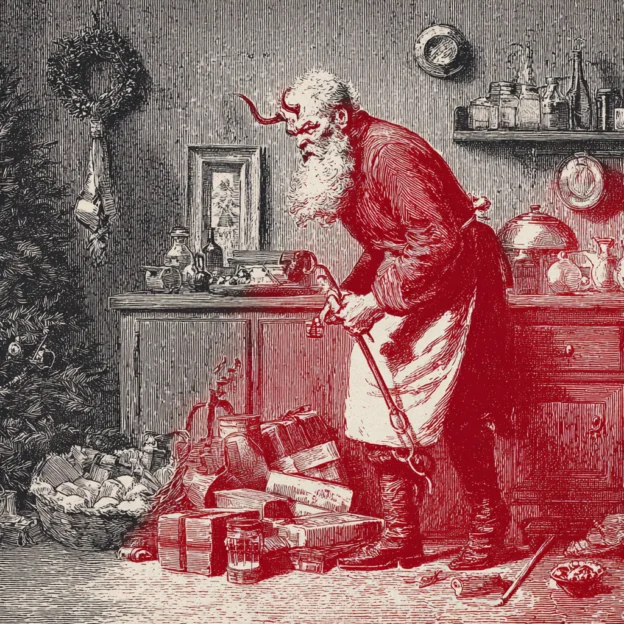
Image by Midjourney.com
First a little historical context. The festival was created to celebrate the birth of Jesus Chris, only… it’s not in the right season because, let’s be honest here, the festival was really just appropriated by the Catholic church to make converting to Christianity that little bit more appealing. The Mid-Winter Solstice was an important festival for many people because it represented safety. The long, somewhat cold winter nights were quite dangerous, and not just in a physical, you’re more likely to get mugged and murdered in the dark kind of way. It was widely believed, both before and after the introduction of Christianity (don’t believe the discourse Europeans would have you believe today, we have always been incredibly superstitious!) that during the winter, the separation between the physical world and the spirit world was the most vulnerable. As such, during December, more malicious spirits would be able to enter the world, ready to strike people down with undiagnosed mental illnesses, which would ultimately result in their ostracization. Ah, history, wasn’t it just such a lovely place to live. Anyway, we’re not here to discuss the absurdity of longing to live in the past, no matter how cool it would be to wear corsets more often. The point I’m trying to make is that it was universally accepted that if people gathered together in large groups for loud and cheery celebrations, then evil would be kept away.
Part of this warning came in the form of putting up decorations. HOWEVER – These decorations should not be put up too early, or the spirits would be warned and attack on mass before the festival was fully prepared! Therefore, the 24th December, the night before Christmas, is the safest time to decorate.
Everyone has some rule about when it’s permissible to put up Christmas decorations. If you’re one of those people who think that Christmas begins directly after Halloween, after Bonfire Night, after Thanksgiving, or after December 1st… you’re all wrong. According to tradition, Christmas begins no earlier than the 24th.
What about taking them down? Everyone knows that they need to come down before Twelfth Night. The 5th January is the feast of Epiphany, and it was believed that all decorations should be removed by this point. Despite almost everyone straying from the Christmas Eve tradition for putting decorations up, taking them down on Twelfth Night has very much stuck. Though it should be noted that if a person is late to take down their decorations, then they are required to keep them up until Candlemas (the 2nd February), a festival celebrating the presentation of Jesus at the temple when he was a baby.
This seems like a pretty amazing idea, particularly if people are willing to leave their pretty outdoor lights on (the ones that sparkle, not the giant inflatable Santa’s, they can go). However, if you leave decorations up after Twelfth Night, they become places for Goblins to inhabit. And with the Goblins comes bad luck, infertility, and death. Which is not particularly cheerful. You might already be thinking that the Goblins have already arrived at your homes. Alternatively, you might be wondering whether or not they would need to social distance or if they would become a part of your bubble. For the most part people are not the biggest fans of Goblins in their house. So, to avoid these unexpected guests, Christmas decorations need to be taken away from the house and burnt, not a pine needle can remain.
What should you use to decorate?
Holly, mainly. Holly, it would seem, is more of a traditional plant than either pine trees or even mistletoe. It was thought to be representative of the crown of thorns that Jesus wore during his crucifixion, which makes zero sense because holly has no thorns, but A+ for effort I suppose. This evergreen plant was believed to protect households against witches and helped to ensure that greenery would return to the world after the winter period is over. Since then, we’ve had somewhat of a revolution on how we view witches and they’re no longer systematically murdered. I think that as a result they are a little less malevolent, so if you want to relegate the use of holly in your decorating to your Christmas cards, then I think you’re still safe. However, if you do still want to deck the halls with boughs of holly (fa, la, la, la, la, la, la, la, la), then take care with which type of holly you get. Spiky leaves suggest that the man would rule the house, while smoother leaves connoted a more feminine sway over the year. It might be prudent to get some of both, just to avoid tension. Unless you’re homosexual, of course, then just decorate with your corresponding leaf shape!
Mistletoe, surprisingly, was actually quite a contentious decoration, and it is more closely linked to New Years Eve than it is to Christmas. You see, although it was believed to protect from lightening, spells and general evil, as well as being thought to be a cure for poison, epilepsy, barrenness and whooping cough, it was also considered super bad luck to bring it into the house too early. In certain parts of England, the destructive powers of mistletoe were thought to be so strong that it was banned from being in churches altogether. But if you do want to take the risk of putting up mistletoe too early, then you might want to take care with the whole kissing tradition. You see, originally the kiss was meant to be accompanied by the giving of a mistletoe berry to the woman. This was supposed to symbolize an offer of getting her with child, which is quite a commitment if you ask me. These mistletoe berries were then considered to be useful for powerful love spells. Unfortunately, these spells often included the consumption of the berry, WHICH YOU SHOULD ABSOLUTELY NOT DO BECAUSE MISTLETOE IS POISONOUS, PLEASE DON’T TRY THIS AT HOME, JUST ASK THE PERSON OUT!
Ivy was also hung up, weirdly, as it is also thought to have malicious qualities when hung inside the house (outside is just fine though). It was believed, however, that at Christmas the feminine ivy and the masculine holly, would work together in harmony. I don’t know why they assigned plants genders, nor why the feminine one is supposed to be evil. It’s probably something to do with history being quite a sexist place to live!
So, I do hope that you have thought carefully about your decorations this year, and that you’ve remembered to hang the right things to keep evil at bay. To be completely honest with you though, 2020 has been such a shit show that I don’t think putting our decorations up early will make the blindest bit of difference. At its core these decorations were put down to creating a cheerful environment to ward off the winter, to spread joy and (if you’re a Christian) to celebrate the birth of the savior of the world. This joy, this warding away of the despondence of the year, has been fulfilled by our early and, some might say, obsessive decorating. So, lets hang our gaudy ornaments with pride. They may not be warding off evil spirits, but they are warding off evil of a different kind.1
What about the tree?
- In some circles it’s considered bad luck to put up a Christmas tree before Before December 1.
- Some people consider Sunday to be the best day of the week to put up a Christmas tree.
We wish we could keep our Christmas trees up year-round. No room will ever feel cozier than when it’s filled with garland, twinkling lights, and of course, a decorated tree. There’s something about walking into a room and smelling the citrusy aroma of a pine tree or having twinkly lights on in the evenings that makes us extraordinarily reluctant to leave this one piece of Christmas behind. Here are three of the most popular dates to take down the tree:
Dec. 31: Take your tree down on New Year’s Eve before the bells toll at midnight. Otherwise, it’s said you’ll be dragging all your baggage and bad luck from last year into the new year… if you’re superstitious about these things, that is.
Jan. 5: Take your tree down on this day, traditionally considered the Twelfth Day of Christmas — i.e., the last of 12 days of Christmas merriment. Think of it as getting closure on the holiday season.
Jan. 6: Take it down on Jan. 6 in observance of the Epiphany, a Christian holiday marking the revelation of God in human form in the person of Jesus. Again, some would say leaving your tree up beyond the 5th or 6th brings bad luck.2
Other Superstitions
- Christmas dinner should consist of nine dishes, including soups, potato salad, bread with honey, fruits, desserts, etc. – and no matter what, alcohol should not be consumed on the eve of Christmas.
- Christmas feast should be set for an even number of guests, because having an odd number of people for the dinner is bad luck.
- An extra plate should be kept ready, to even out the number of people in case some unexpected guest arrives at the time of Christmas dinner.
- All lights should be completely turned off before the stars come out – and then, only after the first star is sighted, can dinner be served on the table.
- The chair of the dining table that has its back to the door should be kept empty, because sitting in such a position may enrage good luck and it may give the house a miss the following year.
- The legs of the dining table should be tied with a rope, in order to safeguard the house from thieves or burglars in the coming year.
- Before beginning Christmas dinner, if you want good luck in the coming year, you should drink three sips of saltwater. Another belief involving water (this from the Swiss for single males) is that on Christmas Eve, drink the water from nine different wells before midnight and then run to the church to see if your future love is waiting for you on the steps.
- Some cultures believe that the first person to leave the dining table after having finished their food will be the first to die in the forthcoming year – so everyone should finish their dinner and leave the table together.
- Bury leftovers around the nearby trees so that they may bear lots of fruit in the coming year, while other regions say the leftovers must be fed to the animals in the area around the house so that no living being goes hungry on the holy occasion of Christmas.3
2 https://www.sheknows.com/living/articles/998585/when-to-take-down-your-christmas-tree/
3 https://www.genealogybank.com/blog/christmas-superstitions-part-2.html