
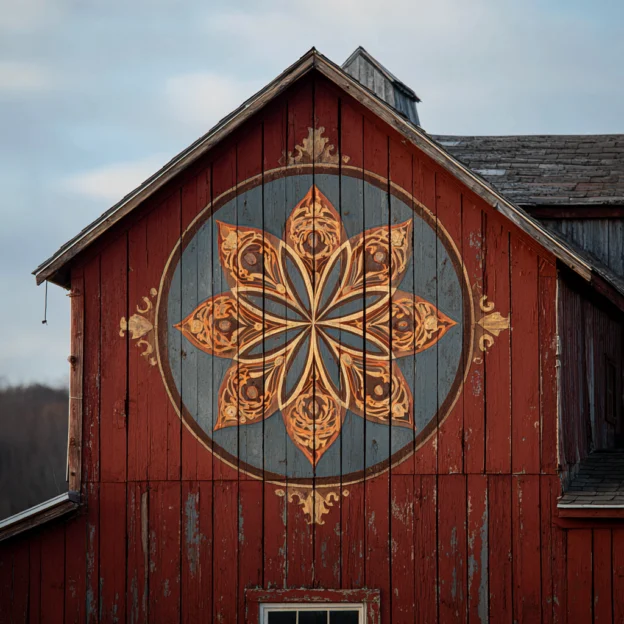
Image by Midjourney.com
There are two opposing schools of belief regarding the derivation of the name. HEX The term hex with occult connotations may derive from the Pennsylvania German word “hex” (German Hexe, Dutch heks), meaning “witch”. However, the term “hex sign” was not used until the 20th century, after 1924 when Wallace Nutting’s book Pennsylvania Beautiful was published. Nutting, who was not a Pennsylvania native, interviewed farmers about their distinctive barn decoration. Before this time there was no standardized term and many Pennsylvania German farmers simply called the signs as a Blume or Sterne (meaning flowers or stars). However one farmer used the term Hexefoos (meaning ‘witch foot’) in his description. The term became popular with Pennsylvania Germans themselves during the blossoming tourist trade of southeastern Pennsylvania.
These signs were traditionally adorned with six-pointed stars. There is also the belief that the origin leading to the term “hex sign” is that English settlers mispronounced the German word for six, “sechs”, as “hex”.
In recent years, hex signs have come to be used by non–Pennsylvania Dutch persons as talismans for folk magic rather than as items of decoration. Some believe that both the Pennsylvania German barn design and hex designs originate with the Alpine Germans. They note that hexes are of pre-Christian Germanic origin; for instance, a circled rosette is called the Sun of the Alps in Padania (the Po Valley). Based on this history, neopagans have taken up the practice of creating hex signs, incorporating other pre-Christian signs and symbols into the hex work. Gandee, in his book Strange Experience, Autobiography of a Hexenmeister, described hex signs as “painted prayers”.
Some view the designs as decorative symbols of ethnic identification, possibly originating in reaction to 19th century attempts made by the government to suppress the Pennsylvania German language. Anabaptist sects in the region, such as the Amish and Mennonites, have a negative view of hex signs, and they are rarely, if ever, seen on an Amish or Mennonite household or farm. – https://en.wikipedia.org/wiki/Hex_sign
Hex signs haven’t anything to do with witchcraft, Satanic ritual or anything evil just as the Pennsylvania Dutch aren’t Dutch, but a Germanic people. OK. There is the high Dutch (German) and low Dutch (Dutch) – in the 18 – 19th Century, the English referred to anyone from the Netherlands, Belgium, Germany, Austria, and Switzerland as Dutch – but, that’s not what we’re discussing here today. Hex signs are works of art created to ward off storms, floods, pests and other farming hazards and mishaps, and are meant to bring blessings to the farmers and their communities and the people within them. The signs offered protection (against evil spirits), prosperity and even fertility to the newly-wed, if the Bride were lucky enough to have been gifted a hex sign to hang on her new home, or barn at her Bridal Shower. In addition to the hex sign, a farmer would often include a “Fire-Letter” – an incantation, hand-printed or copied, which would then be nailed to a rafter in the barn. The incantation written in English, or German that would banish the spirit of fire read: “I command you, Fire, in the power of God, to lay down your flames! – https://hystoria.ca/2016/05/27/pennsylvania-dutch-hex-signs/
|