
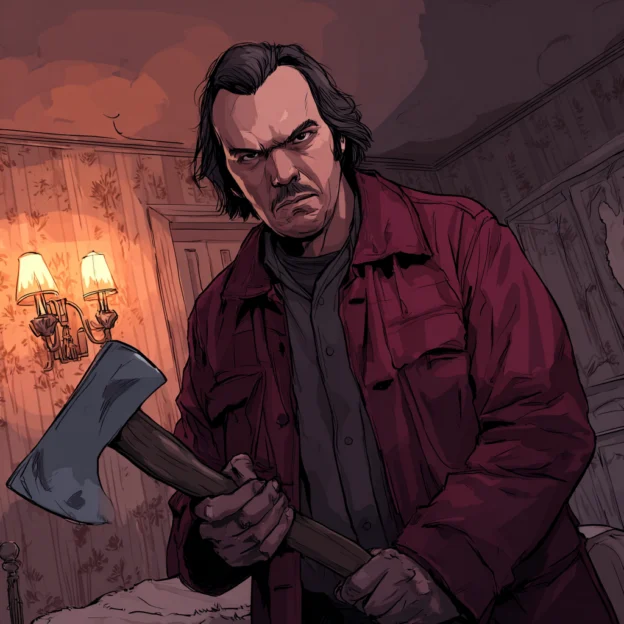
Image by Midjourney.com
In Stanley Kubrick’s psychological horror masterpiece, The Shining, we delve into the complex depths of the human psyche. By applying Sigmund Freud’s psychoanalytic theory, we can explore the film’s themes of the unconscious, repression, and the id, and gain a deeper understanding of the narrative and its characters.
Based on the novel by Stephen King, Stanley Kubrick’s horror classic tells the story of Jack Torrance (Jack Nicholson), an aspiring writer and recovering alcoholic who accepts a position as the off-season caretaker at the isolated Overlook Hotel. His family accompanies him on the job, including his wife Wendy (Shelley Duvall) and his young son Danny Torrance (Danny Lloyd), who possesses “the shining,” an array of psychic abilities that allow him to see the hotel’s horrific past. After a winter storm leaves them snowbound, the supernatural forces inhabiting the hotel influence Jack’s sanity, leaving his wife and son in incredible danger.
Psych Breakdown (literally)
- The Unconscious Mind:
Freud’s concept of the unconscious mind plays a crucial role in The Shining. Jack Torrance, the protagonist, represents the battle between the conscious and unconscious elements of the mind. Throughout the film, Jack’s descent into madness can be interpreted as a manifestation of his unconscious desires and impulses. His repressed anger, revealed by his violent outbursts, mirrors Freud’s belief that repressed emotions can erupt from the unconscious.
- Repression and the Overlook Hotel:
The Overlook Hotel, the eerie setting of The Shining, becomes a symbol of the repressed and haunted aspects of Jack’s mind. Freud’s theory suggests that traumatic experiences are often repressed, and the hotel, with its dark history and supernatural presence, represents these buried traumas. Jack’s obsession with the hotel reflects his repression of past events, and as he succumbs to his repressed desires, he becomes a vessel for the hotel’s malevolent forces.
- The Id, Ego, and Superego:
Freud’s model of the mind, consisting of the id, ego, and superego, helps analyze the characters’ inner conflicts in The Shining. Jack’s id, represented by his primal desires and impulses, drives him towards violence and insanity. The hotel manipulates Jack’s id, emphasizing his repressed sexual and aggressive instincts. Meanwhile, his ego struggles to maintain control, torn between the demands of the id and the constraints of societal norms. Wendy, his wife, serves as the film’s superego, attempting to maintain order and restrain Jack’s destructive impulses.
- The Oedipal Complex:
Freud’s theory of the Oedipal complex sheds light on the strained relationship between Jack and his son, Danny. Jack’s desire to possess the hotel and his growing resentment towards his family symbolize his struggle to exert dominance and suppress his own vulnerabilities. The hotel symbolizes a surrogate mother, attracting Jack’s attention and drawing him away from his actual maternal responsibilities.
Through the lens of Sigmund Freud’s psychoanalytic theory, The Shining is a multi-layered exploration of the human psyche. Stanley Kubrick’s masterful direction skillfully weaves Freudian concepts into the narrative, creating a haunting portrayal of repressed desires, the unconscious mind, and internal conflicts. The film’s enduring power lies in its ability to resonate with audiences on a deeply psychological level, leaving us both captivated and unsettled by the lurking darkness within us all. 1
Danny’s Supernatural abilities:
He has psychic powers that fellow psychic Dick Hallorann calls “shining” – he can read people’s thoughts, communicate telepathically with others who “shine.”
Danny Torrance’s supernatural ability, known as “the shining” (or “the shine”), is a powerful form of psychic ability that encompasses telepathy, clairvoyance, and the capacity to perceive spirits and past or future events.
This ability manifests in several specific ways:
- Telepathy: Danny can read the minds of others and communicate telepathically with people who share the same ability, most notably the Overlook Hotel’s chef, Dick Hallorann. He sends a distress call to Hallorann from hundreds of miles away in the book.
- Precognition & Retrocognition: He experiences vivid visions and premonitions of past and future events that have occurred or will occur in the hotel. These include seeing the murdered Grady twins and the “redrum” message, which is “murder” spelled backward.
- Spirit Interaction: The shining allows him to detect and interact with the supernatural forces and ghosts that inhabit the Overlook Hotel. This intense sensitivity to the hotel’s dark energy makes him a prime target for the malevolent spirits.
- Dissociation/Alter Ego (“Tony”): In the book, his ability is linked to an imaginary friend/inner guide named “Tony,” who is an older, future version of himself. Tony helps him navigate the terrifying events and ultimately use his intellect to outsmart his possessed father in the novel’s climax.2
Tony:
Danny’s supernaturally-charged imaginary friend, Tony, is the locus of the combined subjective and temporal polyphony that the child’s supernatural communion with The Overlook hotel provokes for both Jack and the audience. Tony equips Danny with the ability to perceive how the past and future reverberate in the present, and as a result, Danny has privileged insight into his father’s own psyche: the “shining” of the film’s title. Tony, after all, is a part of Danny’s own consciousness.3
One interesting theory about The Shining suggests that Jack Torrance has the same Shine abilities as Danny and Dick, and it makes a surprising amount of sense. One of the biggest pieces of evidence for the theory actually comes as a byproduct of Doctor Sleep’s story, in which Danny Torrance returns to the Overlook with Abra. Danny reveals that he believes that the Hotel itself preys on the life force of people with supernatural abilities, something which is seemingly confirmed by the spirits absorbed by the hotel. It seems to serve as evidence that the Overlook had an ulterior motive for using Jack to do its bidding.
As the Overlook Hotel seems to feast on and absorb people who can Shine, its targeting of Jack Torrance is telling. Interestingly, the Overlook affects Wendy very little, and it’s only Jack and Danny that truly see the supernatural occurrences that drive Jack to attack his family. This again creates a link between Jack and Danny that can be explained by the theory that Jack Torrance also had the ability to Shine.4 – Niall Gray
If you haven’t seen the movie – give it a watch. If you have seen it – consider a re-watch and, uh, don’t forget to “shine on.”
3 https://www.sensesofcinema.com/2020/the-shining-at-40/uncanny-children-nostalgia-in-doctor-sleep/
4 https://screenrant.com/shining-jack-torrance-shine-powers-theory/