
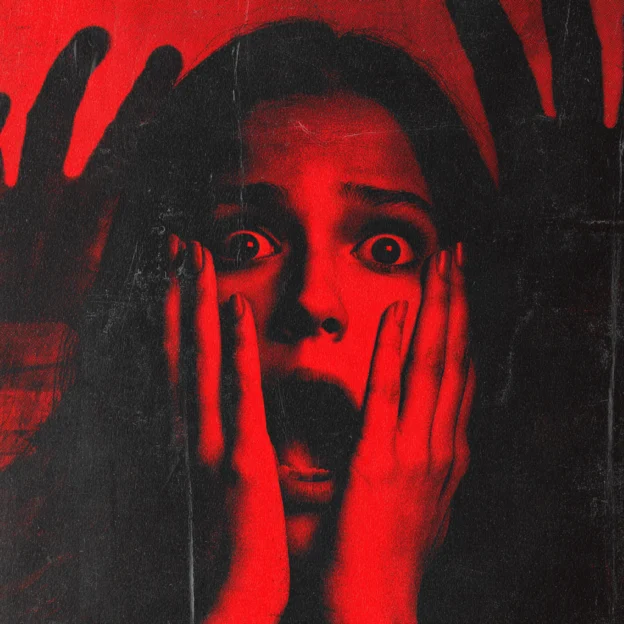
Image by Midjourney.com
Psychological horror is a subgenre focusing on mental, emotional, and psychological states to evoke fear, anxiety, and paranoia, often relying on atmosphere, unsettling narratives, and unreliable perspectives rather than overt gore. It explores themes of madness, isolation, and identity, frequently forcing characters and audiences to question their reality.
Horror movies allow viewers to experience intense fear and thrill in a safe, controlled environment, triggering adrenaline and dopamine releases that many find rewarding. This “voluntary arousing negative emotions” (VANE) approach serves as a form of “fear diet,” building psychological resilience and providing a sense of accomplishment or “surviving” a threat.
One reason we consume horror is to experience stimulation. Exposure to terrifying acts, or even the anticipation of those acts, can stimulate us — both mentally and physically — in opposing ways: negatively (in the form of fear or anxiety) or positively (in the form of excitement or joy). For instance, watching a horror video simultaneously activates both types of stimulation, with the most pleasure experienced at the most fearful moment. The biochemical inside our bodies also changes when we consume horror. Fright can trigger the release of adrenaline, resulting in heightened sensations and surging energy.
Another reason we seek horror is to gain novel experiences. Apocalypse horror films, for example, allow us to live out alternative realities — from zombie outbreaks to alien infestations. Some novel experiences can even contribute to our sense of accomplishment, like visiting a notorious haunted house. Being adventurous in this way makes us feel more worldly or daring (not to mention grants us bragging rights).
Lastly, horror entrainment may help us (safely) satisfy our curiosity about the dark side of human psyche. After all, in real life, we might not have the opportunity to get to know a Hannibal Lecter or wander the streets during The Purge. As an inherently curious species, many of us are fascinated by what our own kind is capable of. Observing storylines in which actors must confront the worst parts of themselves serves as a pseudo character study of the darkest parts of the human condition.
Research suggests that we must possess a psychological “protective frame” to be able to derive pleasure from being horrified. There are three different categories of such frames.
1) We need to believe that we are physically safe — a safety frame. For example, although the evil entity in a movie might be committing terrifying acts in front of our eyes, we can derive pleasure from the horror as long as we believe that the evil entity is physically distant from us and hence cannot cause harm to us. If, however, we start to believe that the evil entity is coming out of the screen to hurt us, then the experience will no longer be fun.
2) The second category of protective frame involves detachment — whether we can psychologically detach from a horror experience. When we see a psychotic murderer chasing down a bloodied victim in a film, we can activate psychological detachment by reminding ourselves that they are just actors, and great acting is what is happening on the screen.
3) The third category of protective frame involves our confidence in controlling and managing the dangers we encounter. If we visit a haunted house, for instance, and a realistic-looking, blood-thirsty zombie charges at us, we can still derive pleasure from the encounter if we feel confident about overcoming the danger. (“We can easily outrun that slow zombie!”)
Research suggests that the absence of any of these psychological protective frames in the moment reduces the preference for horror consumption, which may explain why some people stay away from spooky movies, books, or events.
- Controlled Risk & Thrill: Horror activates the fight-or-flight response without actual danger, offering a “thrill” similar to a rollercoaster.
- Neurochemical Reward: Fright causes the release of endorphins, dopamine, and adrenaline, which can lead to euphoria and an intense sense of relief once the movie ends.
- Curiosity and Simulation: Humans are inherently curious about the “dark side” of the human psyche and enjoy safely exploring taboo or dangerous scenarios.
- The “Scary Spot” Technique: Viewers keep one foot in reality, using coping mechanisms like joking or looking away, allowing them to regulate their fear to a comfortable “sweet spot”.
- Psychological Resilience: Regular exposure to horror may prepare people to manage real-world stress or crises better, acting as a form of exposure therapy.
- Over-arousal: Others find horror mentally and physically exhausting, leading to negative emotions like anxiety, fear, or disgust.
- Sensitivity: Individuals with lower thresholds for danger signals or lower thresholds for stimulation may find the “fight-or-flight” response entirely unpleasant.
- Catharsis: Aristotle’s theory that watching scary or violent events lets audiences release bottled-up negative emotions, such as aggression.
- Dark Tetrad: Research suggests a link between enjoying horror and personality traits related to “dark” aspects of behavior, such as a high need for affect and excitement.
- Rehearsal for Reality: Horror can provide a safe environment to explore life-and-death situations, helping people mentally prepare for potential catastrophes.
This video explores some of the most memorable psychological horror films:
Key Focus:
- Mental Focus: Prioritizes the deterioration of the mind over physical threats.
- Atmosphere & Suspense: Builds tension through suspense, mystery, and eerie moods.
- Unreliable Narrators: Protagonists whose perspective cannot be trusted, often blurring the line between reality and hallucination.
- Personalized Fear: Plays on deep-seated anxieties, paranoia, and internal struggles.
- Classic: Psycho (1960), Rosemary’s Baby (1968), Repulsion (1965), The Shining (1980).
- Modern: The Silence of the Lambs (1991), Black Swan (2010), Get Out (2017), The Babadook (2014).
- Characteristics: These films often use “Nothing Is Scarier” tactics, focusing on what is implied or hidden rather than what is clearly visible.
Psychological horror aims to disturb viewers long after the film ends. It can foster empathy by allowing audiences to deeply engage with a character’s internal conflict and fear. Some research suggests these effects may be more pronounced in female viewers, potentially due to social conditioning.
Some Stats:
- Notably, men are consistently more likely than women to enjoy horror. The gender difference is small but significant. Not only do women enjoy horror less, but they also consume horror media less frequently and prefer their media to be less scary.
- Traumatized people may enjoy horror as a form of “exposure therapy” or safe catharsis, allowing them to process intense emotions like fear and rage in a controlled, manageable setting. By watching traumatic situations resolved onscreen, they can regain a sense of control, master anxiety, and achieve a “false high” from adrenaline release.
Key reasons for this attraction include:
- Controlled Fear & Mastery: Horror movies provide a “safe container” to face fears, as individuals know they are not in actual danger. This can help normalize their fight-or-flight response, reducing anxiety, and building resilience
- Catharsis and Emotional Processing: The genre allows survivors to process buried feelings such as shame, rage, and grief, often leaving them with a sense of relief and calm once the movie ends.
- Recontextualizing Trauma: For some, it can reframe their traumatic memories, allowing them to feel, as one person on Reddit suggested, that they are not alone in their suffering or that the monster/danger can be defeated.
- Validation of Experiences: Intense horror can feel validating for those with CPTSD, acting as a mirror for the intense internal world of “living in a horror movie” they may experience.
3:00 a.m. is considered scary due to a mix of folklore, religious tradition, and biology. Known as the “witching hour” or “Devil’s hour,” it is historically believed to be when the barrier between the living and supernatural is thinnest. Biologically, this time hits at the lowest point of human physical/mental function, causing disorientation and heightened fear.
- The Witching/Devil’s Hour: Folklore suggests that between 3:00 a.m. and 4:00 a.m., paranormal activity peaks, and witches or spirits are most active. It is sometimes called the “Devil’s Hour” as a mockery of the Holy Trinity, often contrasted with 3:00 p.m. (the time of Christ’s death)
- Physiological State: Around 3:00 a.m., the body is in its deepest REM sleep phase, which can be interrupted. Waking suddenly leads to disorientation, low body temperature, and increased feelings of vulnerability.
- Circadian Rhythm Low Point: Human bodies reach their lowest physical and mental energy levels between 2–4 a.m., which can trigger anxiety, irrational fear, and vivid nightmares.
- Psychological Factors: The intense silence and absolute darkness of this time enhance fear, paranoia, and the feeling of being watched, especially if one is alone.
- Cultural Reinforcement: Pop culture, particularly horror films like The Conjuring and The Exorcism of Emily Rose, have solidified 3:00 a.m. as the peak time for ghostly encounters and demonic activity.
- “Hour of the Ox”: Similar to Western legends, Japan has a tradition, Ushi no koku mairi (Hour of the Ox), which falls around this time, associating it with supernatural encounters.
In short, 3:00 a.m. is when your body is weakest and your mind is most vulnerable to the eerie quiet of the night, heavily reinforced by generations of ghost stories.
Understanding the psychology of horror consumption allows us to enjoy the genre more. At the very least, we should get our psychological “protective frame” ready before soaking in all the horror.
https://en.wikipedia.org/wiki/Psychological_horror
https://www.imdb.com/interest/in0000114/
https://hbr.org/2021/10/the-psychology-behind-why-we-love-or-hate-horror
https://www.psychologytoday.com/us/blog/why-we-love-horror/202110/the-psychology-horror-movies
https://www.kirstennoack.com/blog/horror-movies-trauma healing#:~:text=Trauma%20survivors%20may%20like%20horror%20movies%20for,such%20as%20ending%20trauma%2Dbased%20cycles%20or%20patterns.
https://www.youtube.com/watch?v=8v9G_KuGOCI&t=3s
https://www.instagram.com/reel/DRx5ZG6Dm3U/