
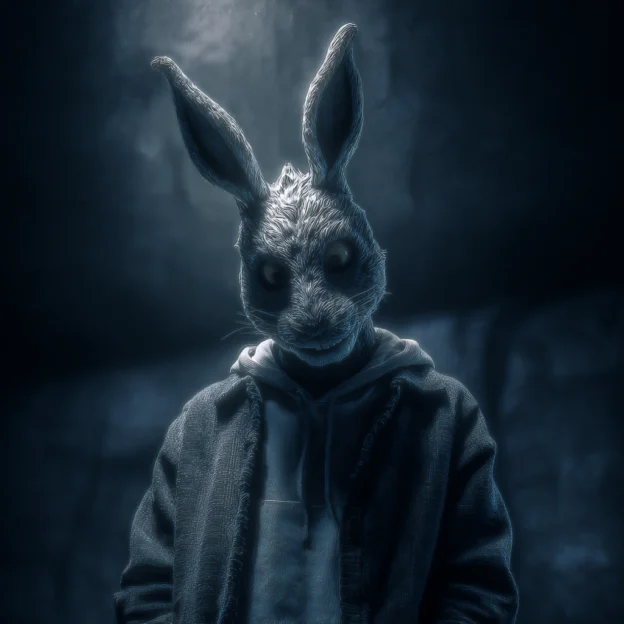
Image by Midjourney.com
Video transcript:
A jet engine falls from the sky. No plane reported missing. No aircraft in distress. Just a massive piece of machinery that appears at 30,000 ft above suburban Virginia and drops straight through the roof of a house, destroying a teenager’s bedroom while he sleeps somewhere else. The Federal Aviation Administration investigates and finds nothing. No explanation, no source. The engine exists. The damage is real. But according to every system designed to track objects in American airspace, that engine shouldn’t exist at all.
This is how Donnie Darko begins. Not with explanation, not with comfortable context, but with an event that violates the rules of reality so fundamentally that the authorities simply close the case and move on. Because acknowledging what happened would require admitting the world doesn’t work the way they’ve been trained to believe it works. And Donnie Darko, the teenage boy who should have died under that engine, stands in the wreckage of his bedroom and asks the question nobody else seems interested in asking. Why am I still alive?
Richard Kelly wrote and directed Donnie Darko in 2001. He was 26 years old, making his first feature film on a budget so small they could barely afford the rights to the 1980s songs that saturate the soundtrack. The film released in October 2001, less than a month after September 11th in a cultural moment when nobody wanted to watch a movie about suburban apocalypse and jet engines falling from the sky. It bombed commercially, disappeared from theaters within weeks, and should have been forgotten entirely. except it wasn’t.
Something about the film wouldn’t let go of the people who saw it. It spread through word of mouth, through bootleg copies, through late night college dorm screenings and internet forums where people tried desperately to decode what they just witnessed. By 2004, it had become a cult phenomenon, a midnight movie that sold out theaters, a cultural artifact that inspired thousands of pages of analysis trying to explain its dense, deliberately cryptic narrative about time travel, parallel universes, sacrifice, and a teenage boy who might be schizophrenic or might be the only person seeing reality clearly.
What almost nobody noticed, what the endless debates about the film’s timeline and physics missed entirely is that Donnie Darko isn’t primarily about time travel at all. It’s a Gnostic allegory so precise, so structurally faithful to ancient Gnostic cosmology that it functions as a modern translation of texts written 1,800 years ago, describing reality as a prison, humanity as trapped in ignorance, and awakening as a catastrophic process that destroys the comfortable illusions keeping you safely asleep.
The film opens with Donnie waking on a golf course at dawn, having sleepwalked there during the night. This isn’t incidental. He’s been called out of his normal sleeping place, pulled away from the location where he was supposed to die by a force he doesn’t understand, operating through mechanisms he can’t see. When he returns home and discovers the engine has destroyed his bedroom, his family treats it as a miracle, as inexplicable good fortune that he happened to be somewhere else when death came calling. But Donnie doesn’t experience it as fortune. He experiences it as the beginning of something wrong, the first crack in consensus reality’s facade. Because the engine shouldn’t exist. Nobody can explain where it came from. and the fact that everyone around him accepts this impossibility and moves on, that they rebuild the bedroom and resume normal life without demanding answers to questions that have no answers. This disturbs Donnie more than the near-death experience itself. He starts seeing Frank, the rabbit figure who called him out of the house appears again, visible only to Donnie, speaking to him in a voice that seems to come from inside his head and outside simultaneously.
Frank tells Donnie the world will end in 28 days, 6 hours, 42 minutes, and 12 seconds. A countdown begins and Frank starts giving Donnie instructions, tasks that seem random or destructive, but that Donnie feels compelled to follow despite not understanding their purpose.
His therapist increases his medication. His parents worry he’s having a psychotic break. His teachers don’t know how to handle a student who started questioning everything, who challenges the self-help guru visiting the school, who floods the building and burns down a house, and argues that fear and love aren’t opposite ends of a spectrum, but that fear is the only real human motivation, and everything else is constructed delusion designed to make the fear bearable. The film presents two possible readings simultaneously and refuses to definitively choose between them. Donnie might be mentally ill, experiencing hallucinations and delusions that his untreated schizophrenia is manifesting as apocalyptic visions and command hallucinations from a figure in a rabbit costume. Or Donnie might be the only person seeing clearly, the only one awake in a world designed to keep everyone asleep. And his illness is actually Gnosis, the dangerous knowledge that the reality everyone accepts as solid and real is actually constructed, temporary, and about to collapse. This ambiguity is itself gnostic. Because in Gnostic thought, the person who awakens, who begins seeing through the material world’s illusion, appears insane to everyone still trapped in the illusion. They speak truths that sound like madness. They perceive realities others can’t access. They’re called prophets by some and lunatics by others. And there’s no external test to definitively prove which interpretation is correct because the very nature of Gnosis is that it’s individual, experiential, unavailable to those who haven’t awakened.
Frank functions as Donnie’s guide, his psychopomp, the figure calling him toward knowledge that will destroy his comfortable existence. But Frank isn’t benevolent. He’s disturbing, threatening, grotesque. The rabbit mask he wears is rotting, decayed, the eye bulging unnaturally from the silver skull beneath. He doesn’t offer comfort. He offers commands. He tells Donnie to commit crimes, to destroy property, to act in ways that will get him arrested or institutionalized or killed. This maps precisely onto the Gnostic concept of the call. In texts like the hymn of the pearl, the divine messenger who comes to wake the sleeping soul doesn’t arrive as peaceful enlightenment. The call is violent, disruptive, catastrophic to the life you were living. It tears you out of the comfortable sleep you didn’t know you were in. It makes you see the prison you were inhabiting as home. And everyone around you, everyone still asleep, treats your awakening as breakdown, as something that needs to be medicated or punished or contained. Donnie’s parents love him, but can’t help him because they’re part of the system he’s waking from. His therapist increases his medication, trying to suppress the visions rather than understand them. His teachers want him to conform, to stop asking questions that don’t have approved answers. Even his girlfriend Gretchen, who loves him and tries to support him, can’t see what he sees. Can’t access the reality he’s perceiving behind consensus reality’s facade.
The film’s antagonist, if it has one, is Jim Cunningham, the motivational speaker who visits Donnie’s school, preaching a self-help gospel of fear versus love. Cunningham’s entire philosophy is designed to keep people functional within the system, to give them simple binaries that prevent deeper questioning. He’s extraordinarily successful, wealthy, admired, the kind of figure parents point to as someone who’s figured out how life works. Donnie sees through him immediately. He stands up in the school assembly and calls Cunningham’s philosophy the worst I’ve ever heard. Which gets him in trouble, but which Frank later validates by leading Donnie to Cunningham’s house, where Donnie discovers a secret room filled with child pornography. The pillar of the community, the man teaching children how to live successfully, is revealed as a predator, as someone whose public persona is constructed precisely to hide what he actually is.
This is pure gnostic cosmology. The archons, the rulers of this world, the authorities who present themselves as guides and protectors are actually predators. They maintain the system that keeps people asleep because the sleep serves their interests. They preach philosophies of compliance disguised as wisdom. They punish those who question, who see through, who refuse to accept the binary choices they offer. and they’re protected by the system itself, by everyone who benefits from not looking too closely, from accepting appearances as truth. The film’s timeline is deliberately confusing, looping back on itself, presenting events that seem to happen in multiple versions simultaneously.
Donnie receives a book called The Philosophy of Time Travel from his elderly neighbor, Roberta Sparrow, who everyone calls Grandma Death because she stands by her mailbox every day waiting for a letter that never comes. The book describes tangent universes, offline timelines that branch from the primary universe and must collapse back into it or risk destroying everything. According to the book’s logic, which the film presents but never definitively endorses, Donnie is living in a tangent universe that began when the jet engine fell. He’s been chosen as the living receiver, someone with unique abilities to manipulate elements within the tangent universe to guide it back toward collapse before it takes the primary universe with it. The manipulated dead, people who die within the tangent universe, can contact the living receiver and help guide the process.
Frank is one of these killed by Donnie in a future that hasn’t happened yet, but that’s already happened within the tangent timeline. If this sounds confusing, that’s intentional. The film refuses to clarify its own mechanics, refuses to explain definitively whether this metaphysical framework is real or whether it’s Donnie’s elaborate delusional system giving structure to his psychotic break. And the refusal to clarify is the point. Because Gnosticism doesn’t offer clear explanations accessible to rational analysis. It offers experiential knowledge, revelation that makes sense to the person receiving it, but that can’t be adequately communicated to or verified by others. Donnie performs the tasks Frank assigns him. He floods the school. He burns down Cunningham’s house, exposing him. He influences others through mechanisms the film suggests but doesn’t explain. The manipulated living drawn to the living receiver, compelled to help the process without understanding why. His English teacher assigns the class to read the destructors, Graham Green’s story about teenage boys methodically destroying a house, which mirrors what Donnie is doing to the fabric of his reality.
Halloween arrives. Donnie and Gretchen go to a party. Frank appears driving a car and runs over Gretchen, killing her. Donnie shoots Frank in the eye, killing him in turn. Which means Frank can now become one of the manipulated dead. Can travel back in time wearing the rabbit costume to call Donnie out of his bedroom on the night the engine falls.
The timeline loops, the paradox completes, and Donnie understands what he has to do. The tangent universe must collapse. The primary universe must be restored. And for that to happen, he must return to his bedroom, must lie down in his bed, must allow the jet engine to fall through the roof, and kill him. His death is the sacrifice required to close the loop, to prevent the tangent universe from expanding until it destroys everything. He goes home, he lies down, he waits, and he laughs. The film shows him laughing in his bed as the engine falls as death comes for him in the form of a piece of machinery that will crush him in his sleep. He’s laughing because he knows. He sees what nobody else sees. He understands the sacrifice he’s making. And there’s something liberating in it. Something that makes the horror bearable. The knowledge that his death will save everyone even though none of them will know it happened. The tangent universe collapses. Reality resets.
Everyone wakes up on October 2nd again.
But this time, Donnie doesn’t wake on the golf course. He dies in his bedroom. The jet engine kills him. And everyone who is part of the tangent universe, everyone whose life was touched by Donnie’s existence during those 28 days wakes with a vague sense of something they can’t quite remember. A dream they had, a person they knew, a feeling that something important happened, but they can’t access the memory directly. Gretchen rides her bike past Donnie’s house. She waves at his mother. Neither knows why. They’ve never met in this timeline, but somewhere beneath conscious memory in the place where the manipulated living retain traces of the tangent universe, they recognize each other. The connection exists even though the events that created it have been erased. This is the Gnostic escape. Not into a better material reality, not into heaven or paradise or any comfortable destination, but out of the prison entirely through sacrifice, through the willingness to be destroyed so that others can continue existing in the illusion without the catastrophic awakening that would come if the tangent universe persisted and they had to confront what reality actually is.
Donnie is the Gnostic Christ figure. He descends into matter, into flesh, into a specific time and place. He awakens to knowledge that isolates him from everyone around him. He perceives realities others can’t access. He’s guided by a figure from beyond the material realm. He performs tasks that appear destructive, but that serve a purpose invisible to those who judge him. And ultimately, he sacrifices himself to save a world that will never know he saved it, that will remember him, if at all, as a troubled teenager who died in a freak accident.
The film structure mirrors Gnostic texts precisely. It presents a cosmology where this reality isn’t the only reality. Where what we perceive as solid and permanent is actually one timeline among many. Where the normal world is a kind of prison that someone from outside must enter to liberate those trapped within. It shows awakening as painful, isolating, catastrophic to normal functioning. It presents authority figures as either clueless or actively malevolent, preaching philosophies designed to keep people compliant.
And it ends with sacrifice with the awakened one choosing death to preserve the sleep of those who can’t handle awakening. Richard Kelly almost certainly didn’t set out to create a gnostic allegory. He said in interviews that the film is about adolescence, about the feeling that the world adults have created is fake and wrong, about the apocalyptic intensity of teenage emotion. But consciously intended or not, he created one of the most precise cinematic translations of Gnostic cosmology since The Matrix. Possibly more precise because it’s less obvious, less designed, less self-aware about its own mythological structure.
The film works on multiple levels simultaneously. You can watch it as a science fiction story about time travel and enjoy the puzzle of its timeline. You can watch it as a psychological drama about mental illness and sympathize with a teenager losing his grip on reality. You can watch it as a coming of age story about first love and loss and the violence of growing up in a world that doesn’t make sense. All these readings are valid. The film supports them. But underneath all of them runs the Gnostic current. The sense that consensus reality is constructed, that awakening to truth is catastrophic, that the authorities maintaining the system are either blind or corrupt, that genuine knowledge isolates you from everyone still asleep, that sacrifice might be required to protect others from truths they can’t handle. and that the world we inhabit is a tangent universe, a deviation from something more real that we’ve forgotten and can’t access, except through revelation that destroys comfortable existence.
Donnie dies laughing because he knows something nobody else knows. He sees what they can’t see. And the knowledge, terrible as it is, is worth the price. That’s the Gnostic promise and curse. Gnosis liberates you from the illusion but destroys your ability to function comfortably within it. You become a stranger in a world you were born into. Awake among sleepers, seeing through structures everyone else accepts as solid and permanent. The film asks whether that awakening is worth it. whether it’s better to see clearly and suffer the isolation and ultimately sacrifice yourself or to remain asleep in comfortable ignorance going through the motions of a life that feels increasingly hollow but at least feels stable.
Donnie chooses awakening. He follows Frank out of his bedroom out of safety into knowledge that will kill him. And the film presents that choice as simultaneously tragic and heroic, as both the destruction of a promising life and the fulfillment of a purpose nobody else could serve. That ambiguity, that refusal to moralize or clarify or tell the audience how to interpret what they’ve witnessed, makes Donnie Darko more gnostic than any film that wears its Gnosticism. Obviously, because Gnosticism doesn’t offer comfortable conclusions, it offers dangerous questions. It offers the possibility that everything you think is real might be constructed. It offers awakening that looks like madness. It offers knowledge that isolates. It offers sacrifice as the only meaningful response to a world gone wrong in ways only you can see. 20 years after its release, Donnie Darko remains difficult to parse, impossible to definitively explain, endlessly rewatchable because it never fully reveals itself.
That’s not a flaw in the film making.
That’s the point. Some truths can’t be stated clearly. Some knowledge can’t be transmitted directly. Some realities can only be glimpsed, experienced, lived through rather than explained. The film is a transmission, not an argument. It shows rather than tells. And what it shows for those willing to see it is the Gnostic vision of reality as prison, awakening as catastrophe, and sacrifice as the only escape that doesn’t abandon everyone still trapped side.
I am teaching my daughter in law english, she’s Chinese, we’ve used US movies as tools to work from. I wanted to use Donnie Darko as our next movie and felt it appropriate to discuss the larger story of the Agnostic Allegory. Although the hidden narrative is a universal one, applicable to all countries, I thought a website would be helpful for introducing this idea. So I build donniedarko.manus.space -she actually likes the movie and the site has been fun to discuss. Also, it wasn’t too difficult for non-programmer like myself to build with Ai, so it’s a nice way to show technology in use for her to see.