
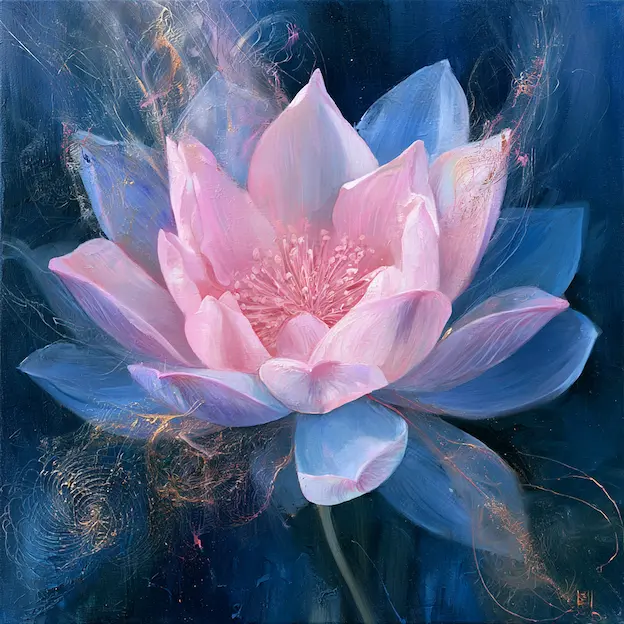
Image by Midjourney.com
The lotus flower is a beautiful and intriguing plant that has been held in high esteem throughout history. It has several important symbolic meanings, which vary depending on the culture.
Lotus flowers are also interesting from an aesthetic point of view. Their graceful beauty and stunning colours allow them to stand out from other flowers. And, of course, the fact that lotuses grow in water only adds to their mystique.
The lotus flower has a variety of different meanings in different cultures. In general, however, the lotus is seen as a symbol of purity, spiritual enlightenment, and rebirth. It is considered sacred in Eastern cultures.
The lotus (Sanskrit: पद्म, romanized: Padmā), Nelumbo nucifera, is an aquatic plant that plays a central role in the art of Indian religions such as Hinduism, Buddhism, Sikhism and Jainism.
Buddhism
In the Buddhist tradition, the lotus flower is associated with Buddha himself. Just as the lotus flower emerges from the mud but remains untouched by it, the Buddha rises pure and untouched by the negative aspects of the world and achieves enlightenment.
The white lotus flower symbolises the purity of body, mind and spirit, while the pink lotus represents Buddha himself.
In the Aṅguttara Nikāya, the Buddha compares himself to a lotus (padma in Sanskrit, in Pali, paduma), saying that the lotus flower rises from the muddy water unstained, as he rises from this world, free from the defilements taught in the specific sutta.
In Buddhist symbolism, the lotus represents purity of the body, speech and mind, as if floating above the murky waters of material attachment and physical desire. According to the traditional biographies, Gautama Buddha’s first seven steps made lotus flowers appear. Lotus thrones are the normal pedestal for most important figures in Buddhist art, and often that of other Indian religions.
In Tibet, Padmasambhava, the Lotus-Born, is considered the Second Buddha, having brought Buddhism to that country by conquering or converting local deities; he is normally depicted sitting on a lotus flower and holding a vajra and a skullcup. One account of his birth is that he appeared inside a lotus flower.
Hinduism
Lotuses are associated with the Hindu goddesses Lakshmi and Vishnu. Both are often depicted sitting on a lotus flower throne or holding lotuses in their hands.
The Hindu divinities Vishnu and Lakshmi are often portrayed on a pink lotus in iconography; historically, many deities, namely Brahma, Saraswati, Lakshmi, and Kubera, usually sit on a stylized lotus throne. In the representation of Vishnu as Padmanabha (Lotus navel), a lotus issues from his navel with Brahma on it. The goddess Saraswati is portrayed on a white lotus. The lotus is the symbol of what is divine or immortal in humanity, and also symbolizes divine perfection. The lotus is the attribute of sun and fire gods. It symbolizes the realization of inner potential, and in Tantric and Yogic traditions, it symbolizes the potential of an individual to harness the flow of energy moving through the chakras (often depicted as wheel-like lotuses) flowering as the thousand-petaled lotus of enlightenment at the top of the skull.
Vishnu is often described as the “Lotus-Eyed One” (Pundarikaks.) The lotus’s unfolding petals suggest the expansion of the soul. The growth of its pure beauty from the mud of its origin holds a benign spiritual promise. In Hindu iconography, other deities, like Ganga and Ganesha, are often depicted with lotus flowers as their seats.
The lotus plant is cited extensively within Puranic and Vedic literature, for example:
One who performs his duty without attachment, surrendering the results unto the Supreme Lord, is unaffected by sinful action, as the lotus is untouched by water.
— Bhagavad Gita 5.10:
In Hinduism, the lotus represents spiritual enlightenment, beauty, fertility, purity, prosperity and eternity. It is said that there’s a lotus flower in every Hindu’s heart, and that when this lotus blooms, the person achieves enlightenment.
The lotus is also an important symbol in the Hindu tantric tradition. In tantra, lotuses represent the energy centres in the body, known as chakras. Each chakra is represented by a lotus with different numbers of petals. The first chakra or the root chakra, located at the base of the spine, is represented by a lotus with four petals, while the seventh and final chakra, also called the crown chakra, is located at the top of the head and has a thousand petals.
Confucianism
In Chinese culture, Confucian scholar Zhou Dunyi (1017–1073) wrote (borrowing from Gautama Buddha’s famous metaphor):
I love the lotus because while growing from mud, it is unstained.
Chinese: 予獨愛蓮之出淤泥而不染。
Jainism
The founders (tirthankaras) of Jainism are portrayed seated or standing on lotus thrones. As his name suggests, the Jain tirthankara Padmaprabha is also represented by the symbol of a lotus. Padmaprabha means ‘bright as a red lotus’ in Sanskrit. It is said in Śvetāmbara sources that his mother had a fancy for a couch of red lotuses – padma – while he was in her womb.
Manichaeism
Chinese Manichaeism borrowed the iconography of Chinese Buddhism, frequently depicting religious figures revered in Manichaeism seated upon lotus thrones in its religious art.
Christianity
Since the introduction of Christianity to India, the iconography of the Saint Thomas Christians has depicted the Saint Thomas Christian cross, also called the Persian cross, resting on a lotus throne, a stylised lotus flower. Likewise, following the introduction of Christianity to China by the Church of the East, the Nestorian cross was frequently depicted on a lotus flower in Chinese Christian iconography.
Ancient Egypt
In Ancient Egypt, the “lotus” was a symbol of rebirth and regeneration and had close connections with the sun. Lotus flowers bloom in the morning and close at night, only to bloom again the next day. This cycle was seen as a metaphor for the cycle of life, death and rebirth.
The blue lotus was particularly revered. It once grew in abundance along the Nile River’s banks, and was seen as a symbol of fertility and abundance. Today, the flower is endangered.
Lotus flowers feature prominently in Ancient Egyptian art, often being depicted alongside Pharaohs and gods. They also feature in hieroglyphs, which were used as a form of writing in Ancient Egypt, in tombs and temples.
However, the Egyptian lotus is not actually a lotus at all, but rather a type of water lily. The blue lotus’ scientific name is Nymphaea caerulea while the white Egyptian lotus’ name is Nymphaea lotus—confusing, right?
And on that note…
Lotuses vs Water Lilies: What’s the Difference?
ou might think that lotuses and water lilies are the same, or that they’d at least be in the same family, but this is not the case. Lotuses belong to the family Nelumbonaceae, while water lilies are in the family Nymphaeaceae.
Lotuses and water lilies do share some similarities in appearance, but there are notable differences between them. The biggest difference is in the way the plants grow. Water lilies tend to float above the surface of the water. Lotuses, on the other hand, submerge their roots in mud at the bottom of the lake or pond, while their stems, leaves and flowers emerge from beneath the water.
Water lilies have a greater colour range than lotuses. Lotuses are generally white or pink but may also be red or yellow, while water lilies come in a rainbow of white, pink, red, yellow, orange, purple and even blue hues.
Lotuses also tend to be larger than water lilies. And, while both flowers are beautiful, lotuses are generally considered more elegant and graceful.
And while the water lily may not have as much religious significance as the lotus, it is the birth flower of the month of July.
What is the “Lotus Effect”?
Lotus leaves are superhydrophobic, meaning they repel water (they make very efficient umbrellas).
As water droplets fall upon the leaves, they gather up dirt and other foreign materials as they roll off the surface, allowing the leaves to self-clean.
This behaviour in nature is termed the “lotus effect”, and it’s something scientists and engineers have begun trying to replicate to create more water-repellent fabrics.
The lotus flower holds various symbolic meanings that extend beyond its beauty. In many cultures, it represents purity and tranquility. The ability of the lotus to rise above muddy waters reflects the human spirit’s capacity to overcome challenges and hardships. This resilience is a powerful reminder of how beauty can emerge from difficult circumstances.
In addition to purity, the lotus is a symbol of spiritual rebirth. Many spiritual practices and philosophies emphasize the idea that, like the lotus, individuals can rise above suffering and emerge renewed. This concept resonates deeply in both Eastern and Western spiritual traditions, making the lotus a universal symbol of hope and transformation.
https://www.floraly.com.au/blogs/news/lotus-flower-meanings?srsltid=AfmBOoqjO05SMSx0JICM2yeNfqenFWAKEwx1dNrWsS1sAIKcHhJvWJt4
https://en.wikipedia.org/wiki/Sacred_lotus_in_religious_art
https://bouqs.com/blog/lotus-flower-meaning-and-symbolism/?srsltid=AfmBOopoZHGVMpiHgDJc-t96GkWBnCclcaTeR2rnjzcLMcKoJGhAUHQA