
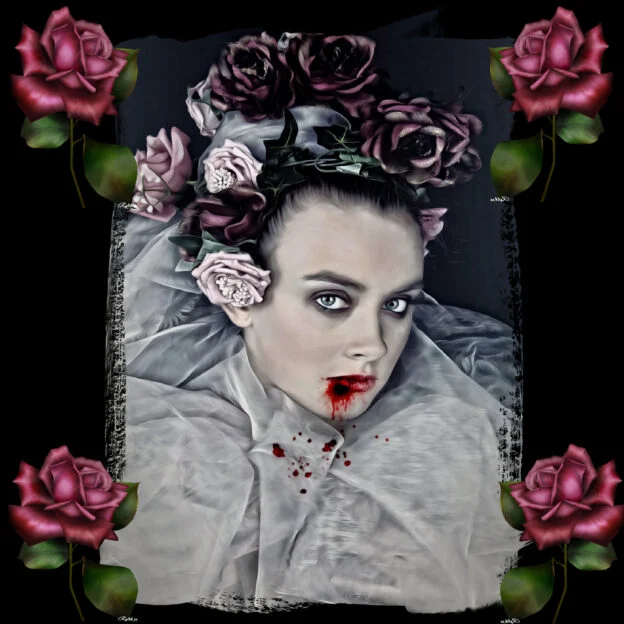
Image by Enrique Meseguer from Pixabay
Countess Elizabeth Bathory (Erzsébet Báthory) was born in 1560, the daughter of prominent Protestant nobility in Hungary. Raised at the family castle in Ecséd, her family controlled the region of Transylvania. Her uncle, Stephen Báthory, later became King of Poland.
Even as a child, Elizabeth displayed tendencies towards psychopathy and sadism. She suffered epileptic seizures and was reportedly prone to uncontrollable rages and acts of cruelty. Elizabeth was also surrounded by bloodthirsty relations and witnessed acts of torture and public executions at the family estate. One can only imagine the effect of these morbid events on an impressionable young girl, whose brain and sense of right and wrong was still developing.
But there’s another, even less-savoury factor, that might explain her later, horrendous behaviour.
It seems that intermarriage with blood relatives was favoured by the Bathory family as a way of preserving the purity of the bloodline. Of course, today, we know that consanguineous marriages (marriages between second cousins or closer) pose an increased risk for offspring to suffer congenital malformations and recessive diseases.
As well as physical illnesses, a child of consanguineous parents is at increased risk of psychoses and severe personality disorders.
It’s also important to know that Elizabeth adopted an attitude common at the time: peasants and servants were seen as ‘less than human’. However abhorrent we might find this attitude today, it does explain her utter indifference to the pain and suffering of her later victims.
At fourteen, Elizabeth bore an illegitimate daughter with a young peasant boy. To avoid bringing shame on Elizabeth’s high born family, the child was taken away to be brought up by another peasant family.
Elizabeth’s punishment? She was sent to live in a convent with nuns in order to repent of her wild ways.
However, only one year later, in 1575, at age fifteen, she married Count Ferencz Nádasdy, a member of another powerful Hungarian family, and subsequently moved to Castle Čachtice (sometimes called Csejte) in Slovakia, a wedding gift from her new husband’s family.
From 1585 to 1595, Báthory bore four more children. By all accounts, she was a doting mother.
A Taste for Torture
According to history, Elizabeth was a highly educated woman and fluent in Hungarian, Greek and Latin. Her husband was, unfortunately, not as intellectually gifted. However, the newly-wedded couple soon found something in common.
Elizabeth’s husband was a soldier and, when he was not away fighting the Turks, it is said that he spent hours and days designing specialist torture tools in the dungeons of his castle such as Iron Maidens and Judas Chairs, anything to inflict the most agonizing, most unimaginable level of pain to his victims.
As you can probably guess, Elizabeth took to her husband’s hobby like a fly to honey!
Cloistered together at their Čachtice estate, they acted out sadistic fantasies on their unfortunate servants. Their reign of torture, cruelty and murder was so extreme, it even shocked sixteenth century Hungary, who had a pretty strong stomach for barbarity. And, when her husband was away, Elizabeth did not ‘lie low’. In fact, she spent the lonely hours practicing new and even more barbaric torture experiences!
As well as their unfortunate servants, Elizabeth summoned a steady supply of young women to her castle. As was the common practice, high-born women did not breastfeed their own children but engaged the services of wet-nurses. So, these young women, new mothers themselves, were taken to Castle Čachtice, totally unaware that their real purpose was to ‘play’ in Elizabeth’s sick, sadistic games.
Without her husband egging her on, Elizabeth surrounded herself with like-mined cronies who encouraged her ‘activities’. There was her bi-sexual aunt, a self-proclaimed witch who delighted in Elizabeth’s cruel hobbies, her childhood nurse and a sadistic manservant named Ficzko.
Elizabeth noted in her diary how long each torture method extended the unfortunate soul’s agony before they died. It is said that the dungeons of Castle Čachtice echoed with the groans and screams of her victims.
A Legacy Bathed in Blood
So, what prompted Elizabeth’s desire for young blood and crafted her legend as a female vampire?
A dark-haired siren with alabaster skin, Elizabeth had always prided herself on her beauty but, at forty-three years of age, she began to see the inevitable signs of ageing.
It appears that a maidservant incurred Elizabeth’s wrath when she accidentally pulled at her hair when brushing it. In a burst of fury, Elizabeth lashed out and scratched the girl whose blood spilt onto Elizabeth’s hand.
Days later, Elizabeth examined her hand and decided the patch of skin where the blood had spilt was white and flawless.
In her own twisted A-hah! moment, Elizabeth decided that the lifeblood of virgins was the miracle elixir she needed to resurrect her vanishing beauty. Her obsession grew and she began to put her humble housemaids to a totally different use.
Assisted by her childhood nurse, the two women roamed the surrounding countryside looking for suitable girls, then offering them a position as a servant at Castle Čachtice. The unsuspecting girls would be led through a maze of underground caves that led straight to the dungeons where they would be enslaved in pits, butchered and their blood harvested for the Countess Bathory to drink and bathe in.
Elizabeth continued her vile pursuits with no fear of penalty, assisted by her enthusiastic accomplices. She might have continued her gruesome beauty routine unnoticed, if she had not made the fateful decision that the blood of noble-born girls might be more effective at keeping her ageing at bay.
To this end, Countess Elizabeth offered her services as a tutor to young noblewomen who wished to better themselves and make excellent marriages. Her aristocratic neighbours were thrilled and eagerly signed up their daughters, not realizing they were condemning them to the depths of hell.
Finally, the numbers of disappearing young women was too great to be ignored.
It is believed that a young man, devastated by the disappearance of his beloved, snuck into the castle and made a horrifying discovery. When he reported what he saw, the authorities raided the castle and found dead and dying girls lying in the dungeons while Elizabeth was upstairs in a room, drunk, and engaging in a torture session.
The Trial of Elizabeth Bathory
Enough was enough.
Elizabeth and her accomplices were finally arrested and put to trial in 1611. Following the testimony of over thirty witnesses, Countess Elizabeth Bathory was found guilty of eighty counts of murder. Staggeringly, her diary, used as evidence, made mention of more than 650 women who had been butchered at Elizabeth’s command.
Elizabeth’s cronies were beheaded then burned at the stake for witchcraft and vampirism.
Being of noble birth, Elizabeth was exempted from this particular punishment and was, instead, bricked up in a small room in Castle Čachtice, with only a narrow slit left for food and water to be passed through.
I can only guess what thoughts went through Elizabeth’s mind as she awaited her death in that tiny room on her own. She died four years later at the age of fifty-four.
Vampire or Victim?
I admit the story of Elizabeth Bathory is hard to believe. It sounds like the sort of horror story that would shock even the likes of Stephen King or Eli Roth.
So was it true? Was Countess Elizabeth Bathory a real-life vampire? Did she really kill over six hundred young women and drink and bathe in their blood to capture the secret of eternal youth?
Some historians have offered other explanations.
Since her husband’s death, Elizabeth had controlled his estate and was deemed a woman of power and importance. Matthias, King of Hungary, owed a large amount of money to Elizabeth.
Some historians believe that the Bathory family wanted to take over Elizabeth’s wealth so they greatly exaggerated the rumours of her murderous pursuits. They then offered to cancel the King’s debt in return for the permission to lock Elizabeth away forever in the castle room. This gave the family free rein to steal Elizabeth’s lands and do with them as they wished.
Other historians have surmised that Elizabeth was insane and her mental state left unchecked and undiagnosed due to her noble birth.
Others still have tried to blame Elizabeth’s behaviour on a difficult menopause!
Despite these conspiracy theories and ‘excuses’, documents and witness statements still exist from her 1611 trial to support the accusations made against Elizabeth. Today, she would be diagnosed a murderous psychopath without a conscience.
One thing is for sure. Elizabeth’s legend grew more depraved in the years following her death, thus cementing her legacy as the archetypal ‘aristocratic vampire’.
She has since spawned countless stories including Bram Stoker’s gothic tale of Count Dracula and Johann Ludwig Tieck’s chilling tale of the beautiful, raven-haired Brunhilda, raised from the dead to feast on the blood of the young to stay beautiful.
The Price of Eternal Youth
So, was Countess Elizabeth Bathory a real-life vampire, a murderous psychopath, or a powerful woman brought down by rumors and rivals?
Her guilt seems undeniable, but so too is the caution her tale offers us today.
While we no longer bathe in virgin blood, our obsession with eternal youth still demands a price, wouldn’t you agree? We chase smooth skin and ageless beauty with needles and scalpels, spending large amounts of money, risking health, identity — and sometimes even our lives — for an illusion that fades no matter how much we pay.
Bathory’s castle may be a ruin and her life the stuff of legend, but the desperate quest to defy time still lives on in mirrors and Instagram feeds everywhere.
The Writrix, Katherine Earle – https://medium.com/never-stop-writing/countess-elizabeth-bathory-real-life-vampire-or-scapegoat-of-history-dd70322adb03