
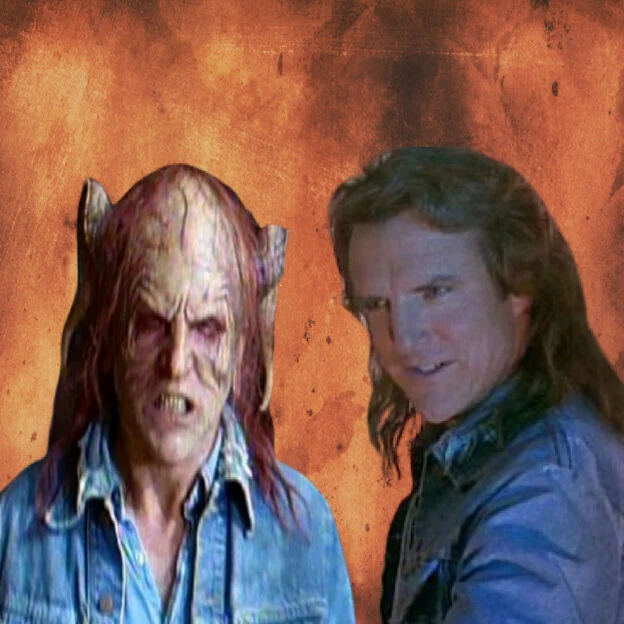
Derivative Images
There is no “real” Randall Flagg, just as there is no real Hannibal Lector; there is only Jeffrey Dahmer, a mute, rat-like man skulking in his hovel.
Randall Flagg is a fictional character created by American author Stephen King, who has appeared in at least nine of his novels and is widely known in the TV movie The Stand. Described as “an accomplished sorcerer and a devoted servant of the Outer Dark”, he has supernatural abilities involving necromancy, prophecy, and influence over animal and human behavior. His goals typically center on bringing down civilizations through destruction and conflict. Flagg first appeared in King’s 1978 novel The Stand as a demonic figure who wreaks havoc after a plague kills most of the world population
The problem with personifying evil in fiction is that the fiction is always so much more interesting than the fact. Milton made Satan into a romantic hero, of a sort, but the reality of evil is much more boring. Dante paints a more accurate picture; his Satan is completely unglamorous—a snot-covered beast sitting on a frozen lake at the bottom of hell. Flagg is described as a “tall man of no age” in old blue jeans, denim jacket and old cowboy boots. He wears an old Boy Scout knapsack and carries pamphlets from dozens of fringe splinter groups in his pockets. Flagg’s background is vague, even to him; he says that at some point he just “became”, although he remembers meeting Lee Harvey Oswald, being a Marine, a Klansman, and a Viet Cong member, and having a hand in the kidnapping of Patty Hearst. In Las Vegas Flagg attracts people drawn to destruction, power and tyranny, using crucifixion, torture and other punishments on those disloyal to him. His followers reorganize society, repairing and restarting services in the city of Las Vegas, Nevada. Flagg plans to attack and destroy a rival emerging civilization—Mother Abagail’s Free Zone in Boulder, Colorado—to become the dominant society in the former United States.
In a career full of iconic villains, King outdid himself in the creation of Randall Flagg. A cross between Charles Manson and Satan, Flagg can be articulate and rambling, intelligent and beastly. I think part of the reason Flagg has become such a mythic figure in King’s body of work is because he can be (like the devil) very charming, when he wants to be. He treats his closest henchmen with something akin to decency, and he seems to have an almost empathetic relationship with some of his victims. This is the Satan of Milton—a fallen angel who was once capable of love, but whose emotions are now limited to the single-minded lust for revenge. When Stephen King created the character of Flagg, he based him around what he believed evil represented. To King, Flagg is “somebody who’s very charismatic, laughs a lot, [is] tremendously attractive to men and women both, and [is] somebody who just appeals to the worst in all of us”.
King wanted Flagg to embody a “gigantic evil”, although he intended the character to weaken by the end of The Stand. He said, “I think the Devil is probably a pretty funny guy. Flagg is like the archetype of everything that I know about real evil, going back all the way to Charles Starkweather in the ’50s—he is somebody who is empty and who has to be filled with other people’s hates, fears, resentments, laughs. Flagg, Koresh, Jim Jones, Hitler—they’re all basically the same guy”. Although Flagg does not explicitly represent Satan, this does not detract from what King sees as his ultimate goal. He notes that no matter who sees him or how he is seen as Flagg appears differently to different individuals, his message is the same: “I know all the things that you want and I can give them to you and all you have to do is give me your soul”.
Randall Flagg is always around. He’s like this…spirit of evil…. To the public, to the world, he first shows up in The Stand, but I wrote a poem called “The Dark Man” when I was in college—I think I was probably a sophomore, so I would have been like twenty—and I wrote it on a napkin in a restaurant…. And I held on to that, and when it came time to write The Stand, I said, “This is what I was thinking about.” This guy, this guy who is like an embodiment of everything that goes wrong with us. All the impulses, the bad feelings. Every time, you know, there’s a quarrel, and it goes beyond words, and somebody gets hurt or gets killed… And I wanted to embody that kind of mindless rage and anger. Evil, if you like. I’m troubled by the question of evil, and I always have been. About whether it comes from inside us—and if it does, why we’re programmed that way to do really shitty things to each other—or if some of it comes from outside, and I’ve never been able to entire solve the question. – Stephen King
https://en.wikipedia.org/wiki/Randall_Flagg
https://bakhtinscigs.wordpress.com/2017/10/31/on-stephen-king-and-the-nature-of-evil/